Also, Barcelona tech, India trade, Paris diplomacy, ‘Made in Europe’
Red Thread

Welcome to Red Thread, Euractiv’s weekly newsletter on the EU’s relationship with China and the wider region.

I’m Christina Zhao in Oceania, joined by Anupriya Datta in Europe.

This week, we look at Beijing’s strategy in global conflicts...

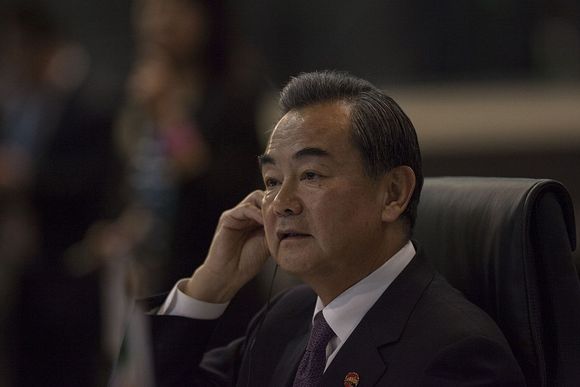
Chinese Foreign Minster Wang Yi (Photo by Ihsaan Haffejee/Anadolu Agency/Getty Images)

From Iraq to Gaza and Venezuela, Beijing has followed a familiar playbook: condemn conflicts, avoid direct involvement, and present itself as a defender of international law.

When the US and Israel launched coordinated strikes on Iran, China responded in a way that has become almost routine. Officials condemned the attack as a violation of sovereignty and called for an immediate ceasefire and a return to diplomacy.

Beyond the statements, Beijing has done little else.

Chinese state media outlets quickly framed the strikes as evidence of American destabilisation in the Middle East, warning they risk triggering wider regional chaos and drawing Washington deeper into conflict. The implication is hardly subtle: while Washington fights wars, Beijing offers stability.

That approach reflects a familiar feature of China’s foreign policy. Beijing stays out of wars, avoids the costs of military intervention, and maintains ties across rival camps while remaining well placed to benefit from the geopolitical fallout.

For China, the conflict carries economic risks. But because Beijing is not fighting, almost any outcome could strengthen its strategic position, Theo Nencini of the ChinaMed Project told Red Thread.

A weakened Tehran could become more dependent on Beijing, increasing China’s leverage. A prolonged war could pull US attention back to the Middle East, easing pressure on China in the Indo-Pacific and diverting Western focus – including Europe’s.

If diplomacy eventually prevails, Beijing can cast itself as the responsible power urging restraint. European capitals are already testing that role: France’s foreign minister Jean-Noël Barrot spoke with China’s Wang Yi this week about possible avenues for de-escalation.

“China will use the conflict to position itself as the defender of the international order and portray the US as the destabiliser,” Bonnie Glaser of the German Marshall Fund told Red Thread. “But it will do little beyond issuing statements and speaking out at the UN.”

Energy security reinforces that caution. Roughly 45% of China’s oil imports pass through the Strait of Hormuz, meaning any disruption would pose a direct economic risk – a vulnerability shared with Europe, which also relies heavily on Gulf energy supplies.

“Beijing’s top interest is preventing economic harm to China,” Glaser said. Nencini added that safeguarding oil flows and preserving regional stability remain Beijing’s overriding priorities in the Gulf.

Yet even here, Beijing’s instinct is not intervention but hedging. China is the largest importer of Iranian crude, buying about 1.3-1.5 million barrels a day since 2023 and accounting for the bulk of Tehran’s oil exports, often at discounted prices.

At the same time, Beijing has been quietly building strategic oil reserves, giving it a buffer against short-term supply shocks. Iran is only one piece of China’s broader Gulf strategy, alongside far larger energy ties with Saudi Arabia and other Arab producers.

Analysts say Beijing’s preferred outcome is neither regime change nor regional chaos. An Iran that remains hostile to Washington but stable enough to continue exporting energy fits China’s strategic interests.

Subscribe to follow the thread.

Got intel, story ideas or feedback? Send them our way.

Advertisement
Policy Conference

China lowers the bar

China has lowered its annual growth target to a range of 4.5-5%, down from 5% in recent years and the weakest expansion goal since 1991, as Beijing acknowledges mounting pressures at home and abroad.


The new target, unveiled during the country’s annual “two sessions” political gathering, reflects a more cautious tone from policymakers grappling with weak consumer spending, a prolonged property slump, demographic decline and rising trade tensions with the US.

Premier Li Qiang used the meeting to signal a strategic shift in how Beijing plans to sustain growth. The government is preparing a new five-year blueprint centred on high-tech manufacturing, innovation and household consumption, while rolling out more than 100 major industrial and infrastructure projects.


At the same time, geopolitical shocks, including disruptions to cheap oil supplies from Iran and Venezuela, are adding another layer of uncertainty to China’s economic outlook.

For Europe: Slower growth will likely mean more exports from China, as Beijing leans on overseas markets to absorb excess industrial output.

EU, India lock trade preferences

Brussels and New Delhi plan to grant each other “Most Favoured Nation” status under their newly agreed trade pact, according to a
draft text, preventing either side from offering better tariff terms to other partners for five years.

The long-delayed agreement aims to eliminate or reduce tariffs on 96.6% of traded goods and could double EU exports to India by 2032. Sensitive agricultural sectors, including dairy, rice and beef, remain outside the deal. Beyond tariffs, the pact deepens cooperation on digital trade, customs procedures and regulatory standards, signalling a broader push by both sides to strengthen economic ties as global trade tensions intensify.

A win for Brussels: The five-year lock-in means any better tariff terms India offers others must also apply to the EU.

Beijing touts ‘eastward shift’ in Barcelona

The surge in Chinese tech exhibitors at this week’s Mobile World Congress in Barcelona is “sending a strong signal that the centre of gravity for global technological innovation is quietly shifting eastward,” wrote the
Global Times, the Communist Party’s state media mouthpiece.

Firms such as Huawei and ZTE, it said, are poised to “take centre stage with sheer strength” at the annual conference.

The messaging comes as European policymakers gather at the GSMA-organised event to promote the EU’s tech ambitions. Tech Commissioner Henna Virkkunen used a keynote to argue Europe must “advance” its tech sovereignty and reduce dependence on US and Chinese technology in critical infrastructure.

State media framed the event differently, highlighting China’s manufacturing sector as the backbone of the global telecoms industry and arguing Chinese firms remain central to next-generation networks and digital infrastructure. “The 5G-A private networks and AI-driven digital transformation platforms provided by Chinese companies to the European market far surpass those of local operators in cost effectiveness,” Global Times wrote.

The strategic play: As Brussels pitches new laws to eject Chinese tech companies from critical infrastructure, Beijing reframes the debate by presenting its tech as unavoidable.

‘Made in Europe’ push targets Beijing

The European Commission on Wednesday unveiled its long-delayed Industrial Accelerator Act, introducing tougher restrictions on Chinese companies and investors operating in the EU, Euractiv’s Stefano Porciello reports.

The measures are set to hit Chinese foreign direct investments in particular. Tailor-made requirements would force Chinese firms operating in sectors such as solar panels, electric vehicles, batteries and critical raw materials to contribute to Europe’s industrial revival if they want access to parts of the EU market.

Industrial Commissioner Stéphane Séjourné said the bloc must retain control over strategic technologies and components. “If we do nothing today... it is highly likely that 100% of cleantech technologies will be produced entirely in China in the coming years,” he warned.

China may still avoid some restrictions in the bloc’s renewable energy auctions by undercutting rivals on price. But the direction of travel is clear: access to EU markets – particularly where public subsidies are involved – will become harder for Chinese players.

Chinese officials and state media described the plan as “protectionist,” divisive among EU capitals and potentially damaging to trade.

Commission security college turns to China

The Commission’s “Security College” of commissioners will meet on 13 April to discuss EU-China relations, according to the College agenda published on Tuesday.

The Security College is an emergency format created by Commission President Ursula von der Leyen to address major security challenges. It was first convened after Russia’s full-scale invasion of Ukraine and brings together the EU’s 27 commissioners to discuss strategic threats.

The upcoming session on China is expected to take the form of a “policy debate,” described in the agenda as an orientation discussion, suggesting Brussels is still defining how it wants to approach Beijing amid rising geopolitical tensions.

In an op-ed Euractiv, Bruegel senior fellow Alicia García Herrero says the US-Israeli strikes on Iran threaten far greater disruption to China’s energy security and diplomatic ambitions than Venezuela ever did. But Trump’s campaign in Iran might backfire to provide Beijing leverage – especially over Taiwan. 

author_name Senior Politics Editor
Christina Zhao
author_name Reporter
Anupriya Datta
Euractiv
Euractiv Media BV - Boulevard Charlemagne 1, Brussels 1041 - Belgium
Copyright © 2026. All rights reserved.