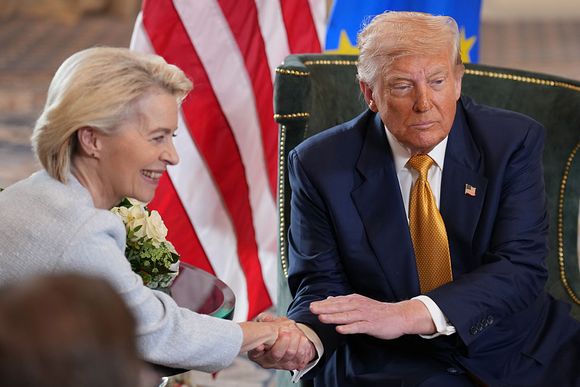
¿Dónde está Ribera? (¡Again!)
Slapping big antitrust fines on US tech firms was once something European commissioners like Margrethe Vestager relished, or at least put a face to. These days, the Commission appears squeamish about giving the news too much oxygen, keen to calibrate the blowback from Washington and perhaps time its announcements as a veiled warning ahead of the next tariff decision.
Thursday’s fine on Google was the third time in two years the Commission has imposed a major antitrust penalty on a US tech company without holding a press conference. Teresa Ribera, the competition commissioner, also did not face journalists when she imposed a €700 million fine on Meta and Apple in April last year, and a €3 billion fine on Google last September.
This time, she could not claim to be travelling. Shirking the glare of the Berlaymont press room again, Ribera instead briefed a hand-picked group of media outlets, which dutifully carried her quotes. “There is no standard rule of having press conferences or not,” a Commission spokesperson said.
Who dares challenge ‘The Authority’?
For the past 10 days, a quiet row has simmered over the appointment of the next director of an obscure yet powerful EU body that calls itself simply ‘The Authority.’ The body, which regulates funding for European political parties, recently made headlines for attempting to ban the party founded by Germany’s AfD. Who gets to lead it next is therefore a political question, and is getting more attention than usual.
Last week, EU ambassadors settled on Philippe Musquar, a French lawyer in the European Parliament’s Legal Service, to replace outgoing director Pascal Schönard. The appointment appeared all but settled. But at the final hurdle, France withheld its approval, delaying the process.
Two diplomats told Euractiv the objections extend beyond Paris. Italy, Germany and Spain also harbour concerns about how the appointment was handled.
Musquar was interviewed jointly by the secretaries general of all three top EU institutions, the Commission, Council and Parliament. Several capitals felt the process was rushed and opaque. Candidates’ CVs, for example, were available only in a secure room at the Council.
Diplomats were also uneasy about Musquar’s apparent political leanings. On LinkedIn, he has shared articles critical of Emmanuel Macron, praised the centre-right Les Républicains, described François-Xavier Bellamy as France’s “most brilliant” MEP, and frequently endorsed Alain Cadec, a centre-right senator. If appointed, his role as director would be to scrutinise the European People’s Party, where Bellamy serves as treasurer.
Hungary stalls Ukraine, Moldova accession
Hungary blocked the next procedural steps in Ukraine and Moldova EU accession talks at a technical meeting on Wednesday, meaning the countries cannot start formal negotiations on internal market and competitiveness reforms, several diplomats and officials told Nicoletta.
The Commission was hoping to open the remaining negotiation clusters before the end of the summer, and is adamant the technical work has been done. But Hungary does not want to give the impression it’s rushing Ukraine’s accession bid, to which Moldova is politically linked. With no breakthrough, movement cannot happen until 1 September when the next technical meeting is scheduled.
A Hungarian government spokesperson declined to comment.
Kosovo: Stop treating us like Serbia’s sidekick
Kosovo shouldn’t have its accession prospects tied to Serbia’s, the country’s ambassador to the EU, Agron Bajrami, told Magnus Lund Nielsen.
Kosovo was “further along than any other country was” when it received candidate status, Bajrami argued. Brussels has too often treated independence as Priština’s biggest prize while asking it to make further concessions to Belgrade. “You can’t treat Kosovo as a lesser party than Serbia,” he said, arguing that the bloc owes Kosovo more than it has so far delivered. Read the full interview.
Far-right petition’s French connection
The publisher of Jean-Marie Le Pen’s memoirs is connected to a far-right petition rejected by Brussels this week, my colleague Elisa Braun writes in to reveal.
The Save Europe Act campaign said it will challenge the Commission’s decision to reject its initiative, which calls for the mass deportation of non-Europeans and a temporary halt to non-Western immigration.
The campaign’s donation portal is linked to a little-known French association, the Centre Européen de Recherches en Sciences Humaines et Religieuses. Public records connect the group to Guillaume de Thieulloy, publisher of Le Pen's memoirs and a network of right-wing, traditionalist Catholic media outlets. One of those publications, Le Salon Beige, has been convicted by French courts over homophobic insults published on its website.
Financial disclosures also show that a fund controlled by Thieulloy has supported the ECR political group and its affiliated foundation, New Direction. His apparent role in the Save Europe campaign centres on fundraising and email operations.
Thieulloy declined to comment on how much money the campaign had raised or whether any proceeds would ultimately support a political party or its planned legal challenge against the Commission.
Here are three new stories from Euractiv: