A primary school student from Shanghai recently demonstrated an AI-powered racing game he designed for people with disabilities.
Speaking at a recent technology forum in Beijing, the boy explained that he had built the game almost entirely through voice prompts because he had not yet learned to type properly.
It was a remarkable snapshot of a generation learning to communicate with machines before mastering keyboards.
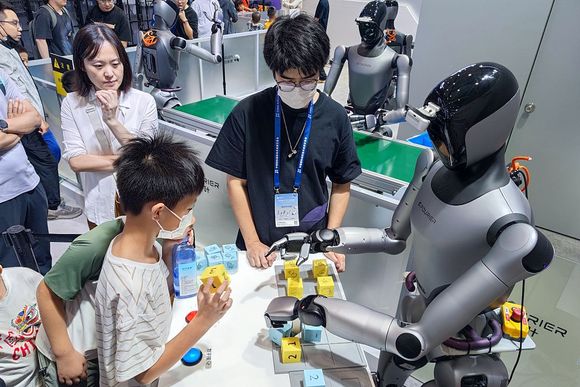
His project was one of many. Other children presented an AI assistant to help visually impaired women apply makeup, a robot capable of monitoring river pollution and smart rehabilitation systems. Together, they showcased one of China’s most ambitious education reforms.
Last week, Beijing authorities said that AI education had reached 1.83 million students across 1,400 schools. State media reported that, days earlier, China’s State Council approved an education plan for 2026-2030 embedding AI across every stage of schooling, extending pilot programmes first launched in Guangzhou in 2022, Shenzhen in 2023 and Shanghai in 2024 into a nationwide strategy.
The reforms complement China’s latest Five-Year Plan, which identifies artificial intelligence as a strategic priority spanning manufacturing, healthcare, education and public services.
While Brussels has concentrated on building the rules, funding and computing infrastructure for AI, Beijing has also begun redesigning the education system around the expectation that the technology will become a routine part of life.
Under Beijing's new curriculum, introduced last September, every primary and secondary school student must receive at least eight hours of dedicated AI education each academic year.
Students are taught how to write prompts, identify AI hallucinations and assess whether a model’s answer is reliable, while schools are encouraged to weave AI into subjects ranging from Mandarin and history to art.
The approach reflects a familiar pattern in Chinese policymaking: pilot reforms in a handful of cities, standardise them, then scale them nationally. The goal is to ensure future generations grow up as native AI users before entering the workforce.
Across Europe, governments are still debating how generative AI should fit into classrooms, how to prevent plagiarism and how to preserve critical thinking in the age of chatbots. While the EU released an AI Literacy Framework last month, no comparable bloc-wide effort exists to make the technology a standard part of compulsory schooling.
Researchers, however, are only beginning to understand how AI changes the way people learn.
One recent study of 26,800 Chinese students found AI helped students complete homework more efficiently, but greater reliance on the technology was associated with weaker exam performance over time.
Subscribe to follow the thread.
Got intel, story ideas or feedback? Send them our way.
|



_20260204092816.png)