Also, Merz vs Weber, Sánchez pod, Kubilius, giant condom
Rapporteur
Powered by

You’re reading Rapporteur on Tuesday 17 March. This is Eddy Wax, joined by Nicoletta Ionta in Brussels.

Need-to-knows:

🟢
The full list of files Hungary is blocking in Brussels

🟢 MEPs again poised to revive EU-US trade talks – or not

🟢 Merz criticises Weber over far-right texts

On the roundabout: Kubilius ‘inspired’ by von der Leyen’s speech

Powered by Amazon
Businesses across Europe grow with the AWS Cloud

xFarm uses the AWS Cloud to support the digital evolution of farming. Its platform helps farmers improve productivity, make data-driven decisions, and keep sustainability at the core of their operations while supporting innovation across Europe. Find out more.

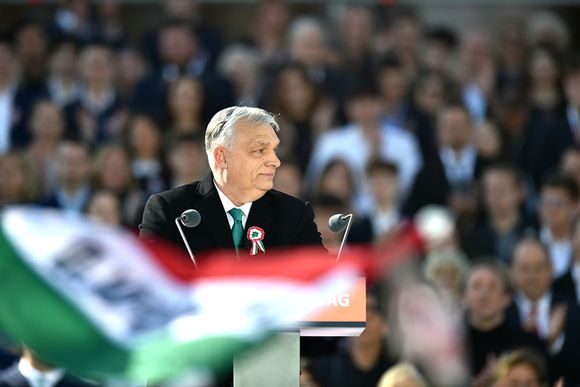
Viktor Orbán (Photo by Balint Szentgallay/NurPhoto via Getty Images)

It was remarkable how little attention EU foreign ministers paid on Monday to the bloc’s pending €90 billion loan for Ukraine, which remains blocked by Viktor Orbán.

The agreement to lend Kyiv the money was trumpeted as a rabbit-out-of-the-hat success at the December leaders’ summit. Yet, because of Hungary’s veto, the EU faces the absurd situation of emerging from this week’s summit no closer to addressing Ukraine’s dire financial needs than it was before Christmas.

Few top-tier European leaders want to risk publicly antagonising Orbán ahead of Hungary’s 12 April election, even if privately many favour his rival Péter Magyar. Their mantra that Orbán must honour the deal he struck in December is hardly surprising, given his government now turbocharges every closed-door criticism into a campaign opportunity. But nor is it particularly courageous.

Passing the buck to the Commission, as some leaders are doing, is an odd strategy. We are a long way from October 2024, when Ursula von der Leyen openly confronted Orbán over his warmth towards Moscow – then, of course, she was campaigning for another term.

In the room on Monday, Poland and Germany vented frustration at Hungary’s obstruction.

But the meeting’s focus was instead on another display of European powerlessness: the swiftly dismissed idea of granting the EU naval mission Aspides a military mandate to help Donald Trump secure the Strait of Hormuz. The mission’s name – Greek for “shields” – should have been a clue it would not turn offensive. Germany, Italy and others ruled it out. “Nobody” wants to join a war they didn’t start, Kaja Kallas said. (My colleague Charles Cohen has a handy explainer here).

At her tightly choreographed press conference, Kallas left the stage when I asked about the loan, eager not to be late for a meeting with her Indian counterpart. No one doubts her support for Kyiv, but she has so far been unable to shift Budapest’s position – nor have national foreign ministers.

She spent more time discussing a draft EU long-term security strategy than the financing plan to avert Ukraine’s fiscal crunch within two years.

The leaders’ caution is odd given the scale of what Hungary is now blocking in Brussels: the €90 billion loan for Ukraine, the use of the European Peace Facility to reimburse weapons donations to Kyiv, the opening of accession talks with Ukraine, the 20th sanctions package on Russia (alongside Slovakia), sanctions on violent Israeli settlers in the West Bank, and measures against Georgia’s ruling Georgian Dream party (again with Slovakia).

Hungary’s vetoes have become so frequent that, according to one diplomat, there are some proposals the EU doesn’t even bother trying to put forward any more.

It will fall to leaders at the European Council later this week to unblock this small stretch of choppy waters into which Europeans have so far not dared to venture.

Crucial week for EU-US trade deal

Lawmakers will make a final push today to decide whether to proceed with a vote on the transatlantic trade deal agreed last year. Parliament called a halt when the US Supreme Court struck down the Trump administration’s 15% blanket tariffs on the EU, plunging Washington’s trade policy into fresh uncertainty.

The centre-right EPP is pushing for a vote in Parliament’s trade committee on Thursday, but liberals and Socialists remain cautious, with a decision expected later today.

Despite the legal uncertainty surrounding its tariffs, the US is urging the EU to move forward with the deal this week. The US ambassador to the EU met on Monday with EPP negotiator Željana Zovko, while Renew’s Karin Karlsbro also held talks with US diplomats the same day, her team told my colleague Sofia Sanchez Manzanaro.

Top Socialist trade MEPs Bernd Lange and Brando Benifei, head of Parliament’s delegation to the US, are due to travel to Washington this week for meetings with US officials.

Weber under fire from Merz

Friedrich Merz said Manfred Weber “bears responsibility” after reports that centre-right and far-right groups – including members of the AfD – coordinated in a WhatsApp group ahead of a migration vote in the European Parliament. Weber told German media he was unaware of the staff chats and hadn’t authorised them.

“The ball is now in Weber’s camp,” Social Democrat MEP René Repasi told Nicoletta in an interview, saying that the revelations pointed to “some sort of cooperation, even of a structured nature.” He warned this could have implications for Germany, where Merz’s coalition deal with Repasi’s SPD bars cooperation with far-right parties.

EPP chief whip Jeroen Lenaers pushed back, telling Rapporteur: “It is quite surprising to see René Repasi invoke the German coalition agreement here, given that his group tends to overlook it when it comes to the substance of migration policy.”

Lenaers added that “the real question now is whether S&D will come to reason and support the Council and Commission proposal on the return regulation in next week’s plenary.”

For Sánchez, el resto es política

In an interview on mega-popular podcast The Rest is Politics, Pedro Sánchez warned that the US administration risks "weakening and undermining” the international order. He criticised what he described as a lack of appetite to "reform and upgrade" existing frameworks, arguing the choice is not between an old or new order – à la von der Leyen – but between "upgrading" the system for the 21st century or sliding back to a 19th-century "law of force."

The Socialist prime minister urged EU leaders to adjust their strategy, leveraging the bloc’s "soft power" while deepening ties with the Global South on migration, climate change, financing and AI regulation. "I think that it is a mistake from Europe to send the message that we believe that the international order is dead," he said.

Defy Trump on digital tax, top MEP says

Pasquale Tridico, chair of Parliament’s subcommittee on tax matters, told Euractiv an EU-wide levy on digital services is needed to make Europe’s tax system fairer, as US companies enjoy soaring corporate profits while EU workers’ wages stagnate.

The Italian lawmaker said Brussels should press ahead despite Trump’s threat to impose “substantial additional tariffs” on countries that introduce digital taxes on Google, Meta and other American tech giants. Read Thomas Møller-Nielsen’s full interview here.

Kubilius delivers von der Leyen’s speech, again: EU Defence Commissioner Andrius Kubilius was full of praise for the controversial ‘project power’ speech von der Leyen delivered early last week, in which she argued Europe cannot remain the custodian of an “old world order” – or in a nutshell, that international law is passé.

The Lithuanian described the speech as “powerful” and said he was “inspired” by it. He went on to quote large tracts of it verbatim at a conference on Tuesday. Commissioner Teresa Ribera already criticised the speech as inadequate. Don’t tell Kubilius that von der Leyen walked it back at the end of the week.

Wrap it up: A seven-metre inflatable condom is popping up outside the European Parliament today as campaigners highlight the lack of male contraceptive options. NGO DSW plans to hand out penis-shaped waffles and invite passers-by to join its cheeky digital campaign, “Time Has Cum.”

BRUSSELS 🇧🇪

Bart De Wever on Monday sought to clarify controversial remarks he made over the weekend, in which he called for a normalisation of ties with Moscow, and rubbished Europe’s prospects of helping Ukraine win the war. He stressed such talks would only be conceivable once the war ends and a peace acceptable to Ukraine and the EU is secured. “We cannot talk about normalising relations as long as there is a war of aggression against Ukraine,” De Wever said.

Nicoletta Ionta

PARIS 🇫🇷

Centre-right Paris mayoral candidate Rachida Dati will join forces with centrist Pierre-Yves Bournazel for the second-round run-off, French media reported. Dati, backed by Les Républicains and the Democratic Movement, secured 25.46% in the first round, behind Socialist Emmanuel Grégoire. Far-left France Unbowed candidate Sophia Chikirou confirmed she will remain in the race.

Charles Szumski

BRATISLAVA 🇸🇰

Robert Fico will travel to Moscow on 9 May for Second World War anniversary commemorations, he confirmed, according to news agency TASR. Fico, who last year was the only EU leader to attend the event, faced strong criticism and clashed with Kaja Kallas, who urged leaders to stay away amid Russia’s war in Ukraine.

Natália Silenská

MADRID 🇪🇸

Volodymyr Zelenskyy will visit Madrid on Wednesday for talks with Pedro Sánchez, his office said. He will sign agreements and hold a joint press conference during his fourth trip to Spain since Russia’s 2022 invasion. The visit comes as Kyiv seeks sustained Western backing and follows a €615 million Spanish military aid package agreed in November.

Martina Monti

WARSAW 🇵🇱

Foreign Minister Radosław Sikorski warned against rhetoric portraying the EU as a greater threat to Poland than Vladimir Putin. Speaking after an EU foreign ministers’ meeting in Brussels, he linked the debate to Karol Nawrocki’s veto of legislation enabling the bloc’s €150 billion SAFE defence loan scheme, cautioning that such narratives risk fuelling dynamics similar to those behind Brexit.

Charles Szumski

PRAGUE 🇨🇿

Industry and Trade Minister Karel Havlíček said Prague was ready to lead an EU expert mission to Ukraine to assess the Druzhba pipeline. After Kyiv reportedly declined to recognise a Hungarian delegation, he proposed that Czechia head a technical team to inspect the route and determine repair timelines, urging the bloc to move the dispute away from “emotional politics” towards practical solutions.

Aneta Zachová

Advertisement
Amazon

AI agents are racing towards mainstream use, forcing EU lawmakers to grapple with tools that act far more autonomously than the systems envisaged under existing rules. Officials say GDPR and the AI Act likely apply, but mounting legal grey areas, from automated contracts to liability when agents go rogue, are fuelling debate over whether new guardrails will be needed.

author_name Newsletter Editor
Eddy Wax
author_name Politics Reporter
Nicoletta Ionta

Contributors: Sofia Sanchez Manzanaro, Charles Cohen, Nikolaus J. Kurmayer, Thomas Møller-Nielsen, Elisa Braun

Editors: Christina Zhao, Sofia Mandilara, Charles Szumski

Euractiv
Euractiv Media BV - Boulevard Charlemagne 1, Brussels 1041 - Belgium
Copyright © 2026. All rights reserved.