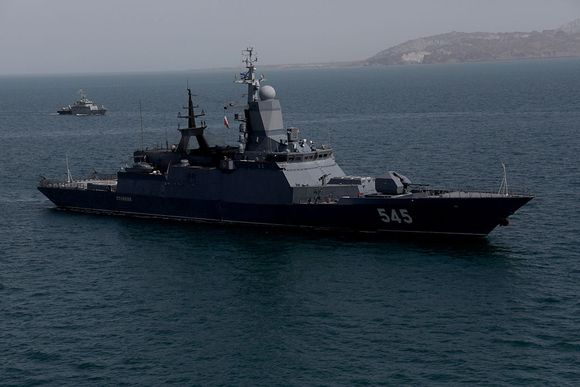
As Iran convulses amid internal turmoil and an emerging leadership vacuum, one external actor has moved with characteristic clarity: Russia. While European capitals debate the legitimacy of Tehran’s so-called “Temporary Council” and weigh their diplomatic posture, Moscow has signalled that it intends to stand by the Islamic Republic – not out of sentiment, but strategy.
The reported (if unconfirmed) refusals to carry out orders within Iran’s security forces and mounting difficulties in command and control suggest a regime under severe strain. Competing factions, many with long records of repression, are scrambling to consolidate authority in the wake of the leader’s death. Yet they lack both legitimacy and broad public backing. Their priority appears less national stability than personal survival.
Crucially, there is nothing ideologically novel about the men now attempting to steady the ship. They are not reformers emerging from within a tired system; they are direct heirs to the revolutionary order established in 1979. The Islamic Republic’s current rulers are the institutional and political continuation of Ayatollah Ruhollah Khomeini and his closest aides – guardians of the same doctrine of clerical supremacy that subordinates popular sovereignty to unelected religious authority.
For that reason, anyone who genuinely speaks of freedom and democracy in Iran cannot coherently support the Islamic Republic in any of its transitional guises. The system itself is constructed to prevent meaningful democratic accountability. Its constitution enshrines oversight by clerical bodies that can veto candidates, legislation and policy. Its security apparatus has repeatedly met peaceful dissent with lethal force. Backing the current leadership, even tactically, risks legitimising a structure explicitly designed to curtail the very freedoms reformists claim to defend.
For Russia, however, weakness in Tehran is not a reason to distance itself. It is a reason to entrench.
Over the past decade, Moscow and Tehran have forged a partnership grounded in shared hostility toward the West and a mutual interest in sanctions evasion. Iran has supplied Russia with drones and other military materiel for its war effort in Ukraine; Russia has reciprocated with diplomatic cover, military technology and expanded economic cooperation. The relationship is transactional but deepening – and instability in Tehran increases Iran’s dependence on the Kremlin.
A fragmented Iranian leadership, cut off from Europe and facing internal dissent, will have few options beyond tightening security ties with Moscow. That dynamic could further integrate Iran into a Russia-led axis stretching from the Black Sea to the Persian Gulf, with implications for European security far beyond the Middle East.
At the same time, segments of the Iranian opposition argue that the regime has revealed its true face through repression at home and hostile actions abroad, and that Europe should sever diplomatic ties entirely. Some rally around figures such as Reza Pahlavi as a potential unifying alternative.
For Europe, the dilemma is acute. Disengagement may allow for moral clarity but risks pushing Tehran even more firmly into Moscow’s embrace. Engagement with a discredited interim leadership, meanwhile, carries reputational and security costs.
What is clear is that Russia will not hesitate. As Iran’s internal order frays, Moscow is positioning itself as indispensable. The question is whether Europe can craft a strategy that supports democratic aspirations in Iran without ceding the field to the Kremlin.