Also, EU Diplomatic Academy, Ben-Gvir, Latvian president
Rapporteur

You’re reading Rapporteur on Thursday 28 May. This is Nicoletta Ionta in Brussels.

Need-to-knows:

🟢 Brussels cools Péter Magyar hopes on frozen funds

🟢 EU diplomats weigh future of scandal-hit academy

🟢 Interview: Latvian president urges EU money for drone-hit Baltics

Advertisement
EuractivPRO

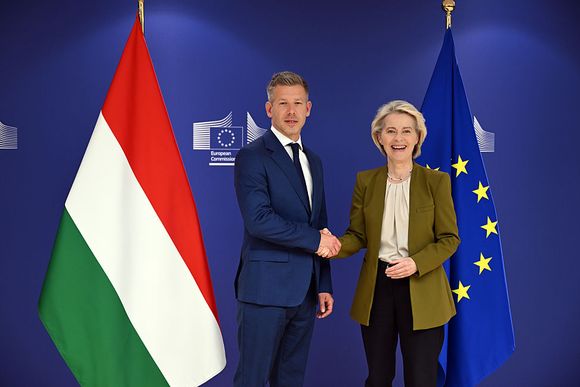
Péter Magyar and Ursula von der Leyen (Photo by Dursun Aydemir/Anadolu via Getty Images)

At last, Ursula von der Leyen and Péter Magyar will meet in Brussels on Friday for a long-awaited rendez-vous intended to break years of deadlock over billions in frozen EU funds.

But tense behind-the-scenes diplomacy and brinkmanship suggest the encounter between the Commission president and Hungary’s new prime minister, who ousted Viktor Orbán, will be anything but smooth.

Talk of a new era and rapprochement between Brussels and Budapest remains premature. The two sides are still far apart, and agreeing even a joint statement is proving difficult.

The Commission has already lowered expectations ahead of the meeting. “The Commission is doing everything to help Budapest move forward,” one senior official said, “but it’s unlikely they will get the €10 billion they are aiming for.”

For Magyar, unlocking the frozen pandemic recovery funds was one of the central promises of his election campaign. And the clock is ticking. Hungary has until the end of August to meet dozens of rule-of-law “milestones” tied to the EU’s Recovery and Resilience Facility, or risk losing access to the payouts under a national plan signed off by Brussels.

The Hungarian PM had earlier projected confidence, saying he expected to strike a political deal with the Commission on the release of the funds. He also said the negotiations extend beyond the immediate release of €10.4 billion in pandemic recovery money and also cover talks over €7 billion in non-refundable cohesion funds.

By midweek, however, the rosy picture looked very different, with confusion in both camps suggesting the talks were far from settled.

While NATO chief Mark Rutte’s office swiftly confirmed a separate meeting with Magyar, the Commission did not confirm any engagement with von der Leyen for days. When confirmation finally came, it was not for Thursday, as expected, but Friday.

Von der Leyen also insisted that Budapest submit detailed implementation plans before locking in any deals. Hungary has been told it must submit its revised national plan immediately, according to one senior Commission official, ahead of the Commission’s end-of-May deadline – now just days away.

The broader political context is also significant. Hungary remains the main obstacle to advancing Ukraine’s EU accession process, having blocked progress in opening the first negotiating “clusters” with Kyiv.

As several Council diplomats told me, the two files are deeply intertwined. Progress on frozen EU funds and movement on Ukraine are now widely viewed as part of the same political equation.

The Commission is expected to formally propose kicking off the process for both Ukraine and Moldova on 16 June, my colleague Magnus Lund Nielsen reported, at a meeting of EU ministers in Brussels.

Pressure builds on Ben-Gvir

EU foreign ministers meeting in Cyprus are set to discuss possible sanctions against Israeli national security minister Itamar Ben-Gvir after several capitals pushed for action over a video appearing to show detained Gaza Aid Flotilla activists being mocked while kneeling with their hands tied behind their backs.

Momentum grew after Antonio Tajani, Italy’s foreign minister, wrote to EU foreign policy chief Kaja Kallas requesting the issue be formally raised at next month’s foreign ministers’ meeting.

Ministers will try to “reach an agreement ahead of the next Council meeting,” Tajani said, though the measure requires unanimity and that is far from guaranteed. He said Germany was likely to support the move, but resistance from the Czech Republic and Bulgaria meant “there is no unanimity.”

France and Spain have already imposed national bans on Ben-Gvir, while Poland has signalled it could follow suit after the latest incidents.

EU diplomats revisit academy scandal

EU foreign affairs diplomats are set to discuss extending and providing fresh funding for the College of Europe’s Diplomatic Academy through 2027, a bloc-funded training programme that is at the centre of a European Public Prosecutor’s Office investigation.

Last December, allegations that the public tender establishing the academy had been tailored in favour of the College of Europe led to the resignation of Federica Mogherini, a former EU foreign policy chief who had been serving as rector and academy director, and Stefano Sannino, an Italian diplomat and former senior Commission official. Both deny wrongdoing and the probe is ongoing.

The discussions will test whether the so-called ‘EEAS gate’ scandal carries political consequences when capitals weigh future EU funding allocations. Diplomats had previously agreed to fund the programme at roughly €1.7 million for 2025-2026.

Any renewal and final funding agreement will require unanimous backing from all 27 EU ambassadors, with discussions expected in the coming weeks.

Latvia urges EU cash for drone-hit regions

Latvian President Edgars Rinkēvičs has urged the EU to consider additional financial support for frontline regions as repeated drone incursions linked to Russia’s war in Ukraine disrupt daily life and hit local economies across the Baltics.

“Local economies are affected, local people are affected. They are actually scared, and for a very good reason,” he told my colleague Alice Tidey in an interview.

Baltic leaders raised the issue with von der Leyen during her visit to Vilnius this week as negotiations over the EU’s next long-term budget intensify in Brussels.

Asked if defence spending should exceed the level proposed by the Commission, Rinkēvičs replied: “Yes.” Read Alice’s full report from Riga.

Endgame on EU-US tariffs deal

EU ambassadors backed last week’s Strasbourg agreement to scrap tariffs on US agricultural and industrial goods, a key element of the implementation of last summer’s Turnberry agreement between Brussels and Washington.

The move follows accusations by Donald Trump that Brussels was dragging its feet over implementation, alongside warnings that the bloc could face fresh tariffs if it failed to comply by 4 July.

Meanwhile, European Parliament deputies are set to vote on the deal in the trade committee on 2 June, ahead of a final plenary vote in Strasbourg on 16 June, according to a preliminary agenda, my colleague Sofia Sanchez Manzanaro tells me.

Here are 3 new stories from Euractiv:

MADRID 🇪🇸

Spain’s Civil Guard raided the headquarters of the ruling Socialist party on Wednesday as part of a corruption probe into alleged covert payments used to finance a network accused of undermining investigations involving figures close to Pedro Sánchez. Spain’s top criminal court is investigating former PSOE official Leire Díez and others over an alleged smear campaign targeting judges, prosecutors and security officials.

Inés Fernández-Pontes

PARIS 🇫🇷

Radical left leader Jean-Luc Mélenchon said he would file a legal complaint against far-right leader Marine Le Pen after she shared an edited video allegedly distorting his remarks on the “new France” concept. Mélenchon accused Le Pen of “manipulation” and falsely attributing statements to him. His France Unbowed party said the phrase referred to a progressive and inclusive vision of France, not ethnicity.

Clara Vassent

OSLO 🇳🇴

Norway joined France’s expanding 'forward' nuclear deterrence scheme on Wednesday as Emmanuel Macron and PM Jonas Gahr Støre signed a broader defence pact in Paris. Under the programme unveiled by Macron in March, participating countries can temporarily host French “strategic air forces” as Europe seeks to strengthen deterrence amid mounting security concerns and uncertainty over US guarantees.

Christina Zhao

WARSAW 🇵🇱

Donald Tusk and Keir Starmer signed a new security and defence treaty in London on Wednesday, deepening military cooperation on joint exercises, cyber defence, drones and critical infrastructure protection. The agreement also covers air defence and missile cooperation and defence industry ties. Both leaders identified Russia as a long-term threat to NATO, with Starmer calling the pact the “biggest step forward” in bilateral defence ties “in a generation”.

Charles Szumski

SOFIA 🇧🇬

PM Rumen Radev called for a “change” in Europe’s Ukraine policy during a visit to Paris on Wednesday, saying the EU should “finally agree to start negotiations with Russia.” Ahead of talks with Emmanuel Macron at the Élysée, Radev warned that pursuing “a conventional victory over the largest nuclear power” risked escalation and said Bulgaria would remain “extremely cautious” on further military and financial aid to Kyiv.

Konstantin Karadjov

TIRANA 🇦🇱

Albanian PM Edi Rama said he would back a proposal to temporarily suspend new EU states’ veto rights on foreign policy issues, arguing enlargement required “creative” solutions as Europe faces war on its doorstep. Speaking alongside Enlargement Commissioner Marta Kos, Rama said Albania would do “whatever it takes” to join the bloc and urged Brussels to speed up accession talks, particularly with Moldova. Read the full story.

– Magnus Lund Nielsen

BELGRADE 🇷🇸

President Aleksandar Vučić said Serbia secured €953 million in new Chinese investment during his China visit, including high-tech projects and training programmes for 500 young people. Vučić also said the first phase of humanoid robot production in Serbia would begin by 15 July, as Belgrade seeks to deepen ties with Beijing beyond infrastructure into robotics, AI and advanced manufacturing. 

Bronwyn Jones

PRAGUE 🇨🇿

The European Commission has asked Czech authorities to clarify whether Andrej Babiš still faces a conflict of interest linked to Agrofert, Czech media reported. Brussels warned subsidies tied to the conglomerate should not be reimbursed from the EU budget until it is clear Babiš no longer benefits from the company. Babiš has long maintained the issue was resolved by placing Agrofert into trust funds.

Aneta Zachová

Nicoletta Ionta Politics Reporter
Nicoletta Ionta

Contributors: Magnus Lund Nielsen, Elisa Braun, Bruno Waterfield, Mátyás Varga, Alice Tidey, Sofia Sanchez Manzanaro

Editors: Christina Zhao, Sofia Mandilara, Charles Szumski

Euractiv
Euractiv Media BV - Boulevard Charlemagne 1, Brussels 1041 - Belgium
Copyright © 2026. All rights reserved.