Also, sanctions deal could unlock Russian visa ban
Rapporteur
Supported by

You’re reading Rapporteur on Monday 21 September. This is Bruno Waterfield in Brussels, with Nicoletta Ionta.

Need-to-knows:

🟢 Wounded Merz rivals Le Pen as EU budget threat

🟢 Sanctions bargain could unlock Russian visa ban

🟢 US-Denmark Greenland deal set for UN signing

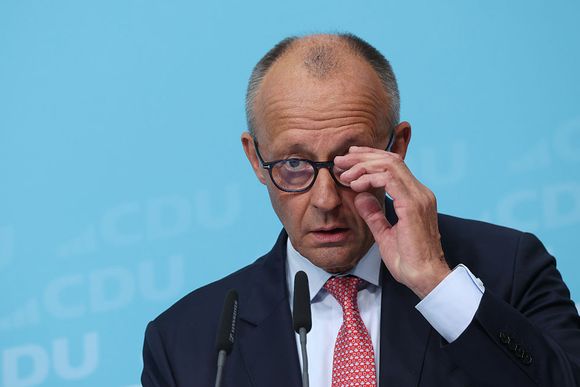
Friedrich Merz [Sean Gallup via Getty Images]

The EU’s push to strike a deal on its next long-term budget has run into a Merz problem.

Almost nothing has been agreed on the bloc’s 2028-2034 spending plan, beyond one point of consensus: a deal must be reached by the end of the year.

Until now, the urgency came largely from France. European governments wanted an agreement safely in place before next spring’s presidential election – and the prospect of a Marine Le Pen victory in May.

But attention is shifting east as EU capitals watch Friedrich Merz’s political position deteriorate at home. Another punishing state election weekend for the German chancellor’s Christian Democrats, with the far right gaining in two states after the CDU’s stunning defeat in Saxony-Anhalt two weeks earlier, has further narrowed his room for manoeuvre.

Merz was already the leading budget hawk. Germany heads a six-country ‘frugal’ camp demanding “several hundred billion euros” in cuts to the European Commission’s proposed €2 trillion spending plan.

With further state elections looming next year and the far-right Alternative for Germany snapping at his heels, however, there is growing concern in Brussels that Merz is being pushed into a position from which compromise may become politically impossible.

Germany is the EU’s largest net contributor. As Merz loses ground and the nationalist, Eurosceptic AfD advances, diplomats fear he will be unable to retreat from demands to curb Berlin’s payments into the bloc’s coffers.

“He is now backed into a corner by the rise of the far right,” one diplomat told Euractiv, echoing concerns spreading across EU capitals.

“The German economy has been in stagnation since 2023 while Merz has expressed tough positions, up to 20% cuts compared to the Commission’s initial proposals,” the diplomat added.

Merz held emergency talks with members from his CDU last night as the party’s preliminary result in Mecklenburg-Western Pomerania put it at 4.9%, below the threshold for entering the state parliament and its worst result in any state election. The CDU was also knocked into second place in Berlin.

“It’s a disaster,” Merz said as the results came in on Sunday night.

On Thursday, he is expected to meet the minister-presidents of Germany’s Länder to discuss “the European budget so that it continues to meet the demands we have going forward.”

Few expect the meeting to produce a U-turn – or soften Merz’s nein to extracting higher EU contributions from German taxpayers.

Merz: No surrender

After a drubbing at the polls – the Christian Democrats shed about 10 percentage points in Berlin, 8 in Mecklenburg-Western Pomerania and 20 in Saxony-Anhalt in the space of two weeks – Merz delivered a statement on Sunday night, an unusual move following state elections, declaring Germany’s 2026 election year over.

His offer to the party now appears to be more of the same: press ahead with reform, whatever the political consequences.

"The reforms have to come," Merz said in the televised address, after elections in which the far-right AfD and far-left Die Linke made the largest gains, while parties opposed to elements of his reform agenda strengthened their hand. The reforms, he argued, were “the antidote to the authoritarian poison that … is penetrating ever deeper into our society.”

"We are taking on this responsibility. I am taking on this responsibility because I want to move our country forward," he added.

Merz, the least popular German chancellor in the nearly 30-year history of the closely watched ARD DeutschlandTrend poll, has looked increasingly vulnerable in recent weeks. He has so far seen off any immediate challenge to his leadership.

"What needs to be done now requires backbone, steadfastness, and patience. I will bring that to bear as CDU party chairman and, above all, as Chancellor of our country."

A sanctions trade-off?

Whispers of a possible trade-off are circulating as EU ambassadors enter last-ditch talks today over the renewal of sanctions on some 3,000 individuals and entities linked to Russia’s invasion of Ukraine.

The key country is France, which, alongside Slovakia, is pushing to ease sanctions on Alisher Usmanov, the Russian-Uzbek oligarch. The move is linked to efforts to secure the release of two French nationals held in Azerbaijan through a prisoner exchange shrouded in secrecy.

Wrangling over Usmanov’s listing, which dates back to 2022, has already forced an emergency one-week extension of the sanctions. That expires on Tuesday, piling pressure on capitals to find a deal.

Talks stalled again on Friday after potential compromise plans to ease restrictions on Usmanov – including a travel ban and asset freeze – failed to win enough support amid anger over France using EU sanctions to pursue a national foreign policy objective.

Countries on the bloc’s eastern flank also fear that diluting the measures would send the wrong message to Russia. Over the weekend, however, a possible bargain emerged that could tighten EU visa restrictions on Russian nationals in return for easing restrictions on Usmanov.

In July, France and Italy – among the countries issuing the most tourist visas to Russian nationals – effectively blocked an EU visa ban on Russians who had fought in Ukraine.

Diplomats from eastern flank countries believe the Usmanov dispute could now give them the leverage needed to swing France behind a visa crackdown that has gained momentum since the Leipzig/Halle airport drone-bomb plot.

Guidelines for a budget that doesn’t exist

Despite opposition in the European Parliament to folding the Common Agricultural Policy (CAP) into a new single-fund structure under the EU’s 2028-2034 budget, the Commission is pressing ahead.

Today, it will present national governments with a first draft of guidelines for drawing up the national and regional partnership plans required to access the funds. The document, seen by my colleague Angelo Di Mambro, will be discussed by the EU Council’s ad hoc working party on the budget.

It is a somewhat speculative exercise, given that the Council has yet to take any formal decision on the national plans. But it also amounts to an implicit acknowledgement that EU countries now largely take the new budget structure as a given, whatever MEPs may think.

Here are three new stories from Euractiv:

Advertisement
Lockheed Martin

‘GOAL TOGETHER’:  A team of drivers won the European Parliament’s in-house football tournament on Friday. The grand finale of the 7 vs 7 contest saw the INLO Strikers, captained by Primo Riganelli, beat TRAD Union 1-0 in Luxembourg.

Teams were drawn from Parliament’s directorates-general and political groups. INLO handles infrastructure and logistics, while TRAD provides translation services. The Left fielded Bella Ciao! Other teams included the ECR Old Lions, KOHL of Duty, Los Spaakos and SAFE Defenders. Brussels may struggle with political unity, but it seems to be well stocked with institutional football puns.

NUUK 🇬🇱 | COPENHAGEN 🇩🇰

Washington and Copenhagen have announced a Greenland security deal that would give the US permanent military access and bar adversaries from bases or sensitive investments on the Arctic island. The unpublished agreement, expected to be signed at the United Nations General Assembly, preserves Danish sovereignty and Greenlandic self-determination, according to their leaders. A US official said it would also allow Washington to build facilities without Danish or Greenlandic approval and remain in force if Greenland became independent.

– Christina Zhao

PARIS 🇫🇷

France’s public debt is set to hit 119.3% of GDP this year, its highest level on record dating back to 1978, as the deficit climbs to 5.4%, the finance ministry said. Debt is forecast to rise further to 121.7% in 2027, when the government plans €54 billion in budget cuts. France remains under special EU monitoring, with its deficit well above the bloc’s 3% limit.

– Christina Zhao

SOFIA 🇧🇬

Bulgaria’s government alleged on Friday that a company owned by the father of its ambassador to the UAE diverted more than €150 million in public guardrail funds through a shell company. The firm was also linked to more than 36 private flights, worth over €5 million, for Delyan Peevski, leader of the ECR-aligned Movement for Rights and Freedoms. Peevski denied wrongdoing. Sofia recalled ambassador Ivan Yordanov and ordered an embassy inspection.

– Konstantin Karadjov

THE HAGUE 🇳🇱

Dutch police arrested 24 people after a far-right anti-immigration protest in The Hague descended into violence over the weekend. Demonstrators hurled fireworks and other objects at officers, while Nazi salutes and antisemitic slogans were reported. Riot police deployed water cannon and dogs after banning a planned march. PM Rob Jetten accused protesters of deliberately seeking confrontation, while Justice Minister David van Weel demanded an “extremely firm” response.

– Charles Szumski

WARSAW 🇵🇱

PiS prime ministerial candidate Przemysław Czarnek said leaving the EU would harm Poland’s interests, while vowing to fight what he called Brussels’ “absurd” policies. Addressing a youth congress in Augustów, he said Poland should remain in the bloc but resist measures that threatened its economy and agriculture. A “war with Brussels” was necessary, he added, but did not mean leaving the EU, as divisions persist on the Polish right.

– Charles Szumski

Politics Editor
Bruno Waterfield
Nicoletta Ionta Politics Reporter
Nicoletta Ionta

Contributors: Sarantis Michalopoulos, Nikolaus J. Kurmayer , Magnus Lund Nielsen, Angelo Di Mambro, Eddy Wax

Editors: Christina Zhao, Sofia Mandilara, Charles Szumski

Euractiv
Euractiv Media BV - Boulevard Charlemagne 1, Brussels 1041 - Belgium
Copyright © 2026. All rights reserved.