Also, Japan’s clickbait diplomacy, Europe Day, French elections
Rapporteur
Powered by

The French elections: Strong first-round showings by both the far right and hard left have sharpened the contours of France’s fragmented political landscape ahead of the 2027 presidential race. But with alliance-building now under way before the 22 March runoff, key urban battlegrounds from Marseille to Paris remain highly unpredictable.

You’re reading Rapporteur on Monday 16 March. This is Eddy Wax, joined by Nicoletta Ionta in Brussels.

Need-to-knows:

🟢
De Wever says Europe should make a deal with Putin

🟢 Interview: German MP criticises von der Leyen’s enlargement strategy

🟢 Japan’s ambassadors in Europe have a new soft power plan

Powered by Amazon
Independent sellers across Europe grow with Amazon

Caroline’s 3Bears set out to help people start their day with high-quality porridge. Today, it’s one of many European small businesses selling on Amazon, reaching customers across Europe and supporting jobs in local and rural communities. Find out more.

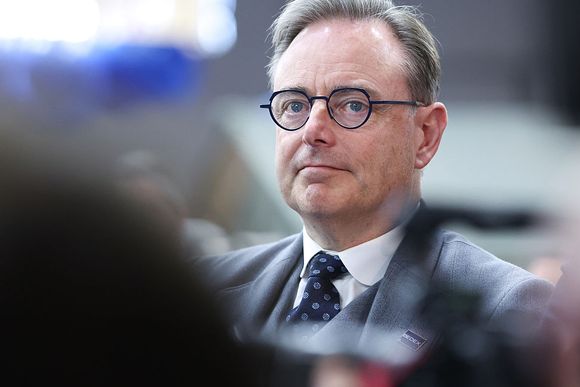
Belgian Prime Minister Bart De Wever (Photo by Omar Havana/Getty Images)

Belgium’s Flemish nationalist Prime Minister Bart De Wever is already a controversial figure in the French-speaking half of his country.

After a weekend media blitz in the French-language press – claiming that Walloons are starting to trust him despite his history of animosity towards the south – he has stirred unease across much of Europe.

“We have to rearm and remilitarise the border. And at the same time we must normalise relations with Russia and regain access to cheap energy,” De Wever told L’Echo, adding that European leaders privately agree with him in one-to-one meetings.

His call to normalise ties with Moscow makes him sound closer to Viktor Orbán or Robert Fico than to his own foreign minister. Right on cue, Maxime Prévot, from a centrist French-speaking party, distanced himself, saying the remarks smacked of weakness.

De Wever has been promoting the French translation of his book Prosperité, which sets out the arguments underpinning his wince-inducing economic reforms to save €4 billion. He told L’Echo that Europe’s inability either to pressure Russia through sufficient arms deliveries to Ukraine or to cripple its economy, and with the US growing less supportive of Ukraine, means Europe has only one choice: making a deal.

As foreign ministers meet in Brussels today ahead of a major EU summit on Thursday, Orbán continues to block a €90 billion EU loan to Ukraine, which he himself agreed to in December. Several European diplomats insisted last week that the loan remains the only viable plan – though that stance may be intended to increase pressure on Orbán. A case in point: one senior EU official acknowledged that a plan B exists, but declined to elaborate.

By urging Europe to engage directly with Putin, De Wever has dredged up a debate that has come in fits and starts in recent months. Emmanuel Macron, Giorgia Meloni and Xavier Bettel have all at times called for talks with Putin. Opposing them are the Baltics, along with Germany, Poland and the Nordics, led in spirit by EU foreign policy chief Kaja Kallas, who has put her own maximalist demands on the table.

For De Wever, the idea that Europe can force Russia to the negotiating table is an “illusion.” The argument now verges on the paradoxical: European leaders are debating whether to speak to Putin, even as the Kremlin has made it clear there is no desire on its side to engage.

Why would Russia seek to negotiate with Europe when it eyes a much more favourable track via the US? With Washington increasingly preoccupied with Iran and diverging from the EU on Russia sanctions, it’s becoming arguably more urgent for Europe to play a role in the peace talks, which have yielded little progress to date.

For years Orbán was the European leader others hid behind, saying things too unpalatable for the bien-pensant EU mainstream. De Wever, who spent many lonely months last year campaigning against the “reparations loan,” now seems to be styling himself in a similar role.

His foray into the media this weekend caused an immediate backlash. Mujtaba Rahman, a director at Eurasia Group and commentator for Politico, said “thankfully no one in the EU cares what Belgium thinks,” before deleting his post. Clearly, however, some do.

Germans shoot down naval mission hype

Foreign ministers will discuss security in the Strait of Hormuz today, one of the world’s most critical shipping routes, effectively choked off by Iran.

Talks will focus on whether more EU countries should contribute capabilities to the bloc’s maritime security mission, Operation Aspides, according to a senior EU diplomat. Several diplomats say national governments are not particularly keen to update the mission’s mandate. Any move to give Aspides an “executive” mandate – allowing it to physically protect escorted vessels and potentially strike – would require unanimous backing.

France said last week it would contribute two additional frigates.

Johann Wadephul, Germany’s foreign minister, said on Sunday he was “very sceptical” that expanding Aspides to the Strait of Hormuz would improve security, arguing the mission has already proven “ineffective” in the Red Sea. Meanwhile, Donald Trump said over the weekend he hoped “many countries” would send warships alongside the US to help keep the strait “open and safe.”

What lies behind Japan’s clickbait diplomacy?

Japan’s ambassadors to France and the UK have become unlikely social media stars, wooing European audiences by immersing themselves in local culture.

The response has been rapturous. Hideo Suzuki racked up thousands of reposts for snaps in front of famous French monuments. His counterpart Hiroshi Suzuki has been hailed in British media for his lovable stunts, including dressing up as a character from Peaky Blinders and singing the Welsh national anthem.

This marks a departure for Japanese envoys, long known for reserve and strict adherence to diplomatic protocol rather than cultivating online followings. But faced with an erratic US and a more assertive China, Tokyo is seeking to deepen alliances in Europe. Read my full story.

Von der Leyen’s Ukraine strategy backfires

A senior German lawmaker has criticised Ursula von der Leyen’s botched attempt to win support for fast-tracking Ukraine into the EU.

“I feel that there is currently a gap between what von der Leyen promises and what she can ultimately deliver,” Anton Hofreiter, chair of the Bundestag’s EU affairs committee, told my colleagues Nikolaus J. Kurmayer and Kjeld Neubert.

The week after the Commission president unsuccessfully floated the idea at an ambassadors' dinner, Hofreiter had little love left for her methods. “The way she prepared and carried it out was not helpful at all,” he said. Read the full interview.

New security strategy divides capitals

EU capitals remain divided – and largely uninformed – about the contents of the bloc’s forthcoming security strategy. Foreign ministers will discuss the plan over breakfast today.

Preliminary talks already reveal clear fault lines among the 27. At a meeting of EU ambassadors on Friday, some countries pushed for a broad definition of security, while others voiced scepticism, warning that an overly expansive approach could dilute focus or overlap with existing policies. Read Charles Cohen's full story.

Metsola in Berlin as proxy vote push advances

Roberta Metsola kicks off a two-day official visit to Berlin today as her campaign to secure more flexible voting rules for pregnant MEPs inches to the finish line.

On Friday, ambassadors greenlit changes allowing MEPs to nominate a proxy before giving birth and for a few months afterwards. Germany abstained over legal concerns, while Portugal held back pending parliamentary approval – though ministers are expected to wave through the rule changes anyway at a meeting on Tuesday.

Palantir’s Thiel makes Rome stop

Peter Thiel, Palantir co-founder and outspoken Trump supporter, arrived in Rome on Sunday for a closed-door seminar, prompting questions over possible contacts with Meloni’s government, Charles Cohen reports.

Lawmakers have asked whether meetings with officials are planned and if Palantir has any contractual ties with the Italian public administration, as the company expands its role in government data analysis and defence.

The visit coincides with a private lecture series on the Antichrist organised with the Gioberti Association. Scrutiny intensified after reports that Italy’s defence ministry launched a procurement process in 2024 for Palantir’s Gotham platform.

Europe Day is payday: MEPs will be able to claim €359 for attending ‘Europe Day’ events in May, Rapporteur can reveal. “Jean Monnet is turning in his grave,” one parliamentary insider remarked. Read the full story.

Uncompetitive pricing: Attending a “luncheon debate” with EU competition chief Teresa Ribera at the Spanish Chamber of Commerce in Brussels on Tuesday will cost €132 – or €95 for members.

PARIS 🇫🇷

France’s municipal elections are reshaping a local landscape long dominated by traditional parties. In Sunday’s first round, Marine Le Pen’s far-right National Rally and Jean-Luc Mélenchon’s radical-left La France Insoumise posted strong results, potentially widening their local footholds ahead of next year’s presidential race. LFI advanced in cities including Roubaix, Toulouse and Lille, while the RN consolidated support in the south, notably in Toulon, Nice and Marseille.

– Elisa Braun

MADRID 🇪🇸

The centre-right Popular Party won the most votes in Sunday’s elections in Castilla y León, securing 35.5%, up from 31% previously. However, the far-right Vox party’s 18.9% share signals difficult coalition talks ahead for regional president Alfonso Fernández Mañueco. In this PP stronghold, the Socialists came second with 30.8%, while the nationalist León's People's Union took 4%.

– Inés Fernández-Pontes

THE HAGUE 🇳🇱

Dutch businessman Niels Troost has been removed from the EU sanctions list. He was the first EU resident designated in December 2024, when his company, Paramount Energy and Commodities DMCC, was accused of trading Russian oil above the price cap. Dutch media reported his removal this weekend. Troost reiterated his innocence and said he had suffered reputational damage from what he described as a smear campaign by a former business partner.

Lisa Dupuy

WARSAW 🇵🇱

Donald Tusk warned on Sunday that “Polexit is now a real threat,” accusing both wings of the far-right Confederation alliance and much of the national-conservative Law and Justice of favouring an EU exit, with Karol Nawrocki acting as their patron. Writing on social media, Tusk said he would do “everything” to prevent Poland leaving the bloc. The comments followed Nawrocki’s veto of legislation implementing the EU’s €150 billion defence financing scheme, SAFE.

Charles Szumski

BRATISLAVA 🇸🇰

Robert Fico’s coalition partners voiced confusion over Slovakia’s brief push to remove Russian oligarchs Mikhail Fridman and Alisher Usmanov from the EU sanctions list – a move Bratislava later dropped. Social Democratic leader Matúš Šutaj Eštok said he did not understand the step and would question the foreign minister. Smer MP Marián Kéry said on Sunday the delisting “was not in Slovakia’s interest,” without indicating whose interests it would have served.

Natália Silenská

Advertisement
Amazon

Mojtaba Khamenei’s continued public absence after being selected as Iran’s new supreme leader has raised questions within the Islamic Republic over who is exercising authority, according to Western officials monitoring developments.

The uncertainty comes as Iran’s security apparatus faces mounting strain from US-Israeli strikes and economic pressures, fuelling concerns about the regime’s stability.

Ukraine’s rapidly expanding defence industry is attracting strong foreign investor interest, but Western financiers are increasingly seeking intellectual property rights or exclusive access in exchange for funding.

Lawyers and analysts warn that many Ukrainian drone makers lack adequate protections, raising the risk that key wartime innovations could ultimately be registered abroad as international demand for Kyiv’s anti-drone expertise grows.

author_name Newsletter Editor
Eddy Wax
author_name Politics Reporter
Nicoletta Ionta

Contributors: Charles Cohen, Martina Monti, Nikolaus J. Kurmayer, Elisa Braun

Editors: Christina Zhao, Sofia Mandilara

Euractiv
Euractiv Media BV - Boulevard Charlemagne 1, Brussels 1041 - Belgium
Copyright © 2026. All rights reserved.