Rapporteur
Powered by

It promises to be a cold, quiet week in Brussels. For exciting events, you can choose between a Eurogroup meeting or a “communication” from Raffaele Fitto on the EU’s eastern border regions.

The real action lies elsewhere. In Geneva on Tuesday, the US will host peace talks between Russia and Ukraine, alongside separate discussions with Iran. On Thursday, Donald Trump will host the first meeting of his "Board of Peace" in Washington, with Italy, Romania and Cyprus attending as observers. Emmanuel Macron and Pedro Sánchez are in India this week.

You're reading Monday’s Rapporteur on Monday 16 February. This is
Eddy Wax, with Nicoletta Ionta in Brussels.

Need-to-knows:

🟢 Key takeaways from Munich

🟢 Italy, Romania, Cyprus to join Trump’s ‘Board of Peace’

🟢 S&D fractures over Sánchez’s migration policy

Powered by European Commission’s Directorate-General for Employment, Social Affairs and Inclusion
The European Employment and Social Rights Forum is back.

This year’s edition will address the EU’s response to the challenges many people face today: the rising cost of living, job insecurity, and changes in the labour market. Join us to explore bold ideas for supporting Europe’s greatest strength: its people.

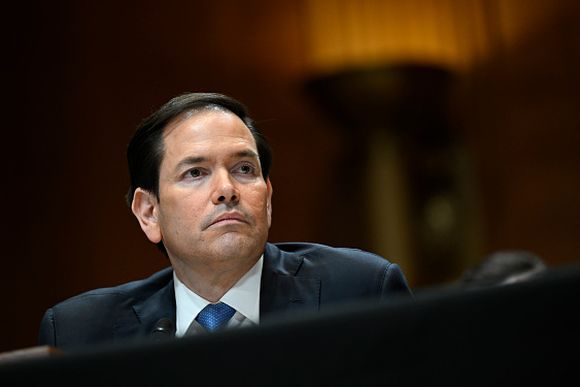
US Secretary of State Marco Rubio (Photo by Matt McClain via Getty Images)

Marco Rubio’s 22-minute speech at the Munich Security Conference achieved its immediate aim: getting the Europeans to chill out. There’s no evidence that they should, though.

The US secretary of state arrived intent on striking a more conciliatory tone than JD Vance did in his tirade at last year’s conference. Rubio invoked “friends” five times and “together” no fewer than 25. To the casual listener, it sounded like a recommitment to the transatlantic alliance after a year of deafening American threats.

But Rubio’s offer was not one of partnership among equals. He made clear the US was willing to go it alone if necessary. And his recounting of the story of European “civilisation” only sounded positive when he turned the clock back decades, or even centuries.

A Christian nationalist sermon mixed with an imperialist conscription advert, he focused on the ills of migration, the “climate cult,” the pointlessness of international institutions, and his glorification of raw military power. That should spook European governments. The only time he mentioned Ukraine was to bash the United Nations.

He was preaching to the converted: the Europeans in the room were desperate to hear that the Americans have not forsaken them, and that’s essentially what he gave them.

After a baffling standing ovation, the
nonsensical reactions rolled in. Wolfgang Ischinger, the conference’s chief, immediately thanked him for his “message of reassurance.” Ursula von der Leyen described herself as “very much reassured” in a conversation on stage with Christiane Amanpour. (Though she had already called for the EU to beef up its largely irrelevant mutual defence clause.)

Others pointed to signs of renewed momentum around the EU: Volodymyr Zelenskyy pushed for a clearer accession timetable, Keir Starmer signalled closer ties, and Emmanuel Macron, the architect of can-do “strategic autonomy,” engaged in typical boosterism about the merits of the bloc.

But Munich didn't alter the fundamentals. From Germany, Rubio was straight on a plane to Slovakia – where he
suggested the government could host Ukraine peace talks – and then to Hungary, another Russia-friendly EU government.

Euractiv columnist Ilana Bet-El
asks in her piece today why Munich is even taking place at all, particularly so soon after Davos, where all the same people had already convened. “They reflect nothing more than enclosures of self-satisfied officials and surrounding advisers, think-tankers and journalists talking about a world they are completely detached from,” she writes.

In the US press, much is made of the supposed rivalry between Rubio and Vance, each cast as representing a different strand of the MAGA movement. But nothing Rubio said in Munich was incompatible with Vance’s sharper message last year.

The US is still threatening to break up with Europe; Europe is still threatening to go it alone. Neither is very realistic.

Activist death roils French politics

Macron on Sunday urged “calm, restraint and respect” after a 23-year-old activist was killed following an assault on the fringes of a rally organised by the far-left France Unbowed party. National Rally leader Marine Le Pen had earlier called for far-left “militias” to be designated as “terrorist groups.” Alice Weidel, co-leader of Germany’s Alternative for Germany, endorsed the proposal, citing what she described as the “impunity” of “antifa” groups across Europe.

Italy, Romania and Cyprus to join Board of Peace

Italy, Romania and Cyprus are preparing to join Donald Trump’s controversial Board of Peace – but only as observers, stopping short of full membership amid mounting legal and constitutional concerns. Trump has convened the inaugural meeting in Washington for Thursday. EU Mediterranean Commissioner Dubravka Šuica is also expected to attend.

Speaking in Munich over the weekend, Kaja Kallas cited the initiative as an example of flawed diplomacy. Whereas the EU seeks partnerships based on “dignity,” she said, under the Board’s charter “one person can make the decisions.” “That is, I think, the difference [in] how we see the world,” she added.

Officials at Kallas' European External Action Service have
raised legal concerns about the Board’s charter, questioning its governance and compatibility with EU and UN principles.  Read the full story.

Socialists split over Sánchez’s regularisation move

Spanish and Danish socialists are
again at loggerheads over migration, this time over Pedro Sánchez’s plan to grant residency papers to around 500,000 migrants in Spain – a move that has unsettled Danish Social Democrat MEPs.

An S&D briefing note, prepared ahead of this month’s plenary debate and seen by Magnus Lund Nielsen, urged lawmakers to frame the measure as “positive and humane” and to argue that it constitutes a standard migration policy.

Christel Schaldemose, a senior Danish S&D lawmaker, told Magnus she would scrutinise the implications for the Schengen area, noting that beneficiaries would gain access to free travel. Still, she insisted the S&D group remained “100% viable,” describing it as a political family in which
disagreement is inevitable. “On migration, the Danish Social Democratic position is in the minority,” she said.

MEPs probe Spain’s rule of law

A five-member delegation from the European Parliament’s civil liberties committee arrives in Madrid today to assess Spain’s anti-corruption framework, rule-of-law standards and judicial independence.

The group – which includes far-right Vox MEP Jorge Buxadé and Javier Zarzalejos of the centre-right PP – will meet justice ministry officials, the presidents of the Supreme and Constitutional Courts, the newly appointed Attorney General Teresa Peramato, and representatives of magistrates’ associations. The opposition PP criticised Pedro Sánchez and his ministers for declining to receive the delegation, as the government faces heightened scrutiny
amid corruption allegations.

The visit comes after the centre-right European People’s Party
voted down a planned Parliament mission to Italy late last year, blocking a visit that had been agreed by committee coordinators to assess the situation in Rome and prompting accusations of political selectivity to protect Giorgia Meloni, an ally of the EPP.

Far right weaponises EU health debate

As MEPs advance the Critical Medicines Act to tackle drug shortages, far-right lawmakers are using health debates to relitigate Covid grievances and challenge the EU’s competence in public health, Euractiv’s health editor Brenda Strohmaier reports. From vaccine scepticism to abortion politics, they are reframing technical legislation as a broader struggle over identity, sovereignty and personal freedom.

Brussels gets a drugs commissioner: After over 600 days of political deadlock, Brussels finally puffed out its own white smoke. The coalition deal parks Metro 3 for a decade – trams will inherit the tunnels instead – while Brussels will get its very own drugs commissioner to juggle safety, prevention and public health. The agreement reduces 80% of the current budget gap to balance the books by 2029. Underground trash containers are expanding, smart cameras are coming for fly-tippers, and there’s a shiny new masterplan for bilingualism.

PARIS 🇫🇷

A by-election victory in Haute-Savoie has drawn attention to a discreet but well-funded network preparing France’s far right for 2026. At its centre is Politicae, a candidate-training group backed by Périclès, the €150 million fund founded by Belgian-based billionaire Pierre-Édouard Stérin. Though publicly non-partisan,
leaked documents suggest it aims to help the National Rally convert national gains into control of up to 300 municipalities. Read the full story.

Laurent Geslin

NICOSIA 🇨🇾

Cyprus, currently holding the EU Council presidency, will attend Trump’s Board of Peace meeting on Gaza as an observer, the government said on Saturday. The foreign ministry said the EU state closest to the region “partakes in the evolving developments” and contributes in practical terms to stability efforts. Greece
will not participate, citing Kyriakos Mitsotakis’ schedule. A former NATO official told Euractiv last week that both countries should attend, arguing that Israel would welcome their presence.

– Sarantis Michalopoulos

BUDAPEST 🇭🇺

Ramping up his campaign rhetoric, Viktor Orbán said the EU poses a
greater threat to Hungary than Russia does, in a speech on Saturday. He took aim at his challenger Péter Magyar, claiming he's controlled by EPP chief Manfred Weber. Magyar spent the weekend at the Munich Security Conference, pressing the flesh with Europe’s top brass, including Donald Tusk and Friedrich Merz. In his own speech Sunday, Magyar accused Orbán of threatening to release an illegally filmed sex tape of him.

Eddy Wax

MADRID 🇪🇸

Spain’s opposition leader Alberto Núñez Feijóo said he remains committed to governing alone but is open to “specific agreements” with the far-right Vox party. In an interview with El Mundo, the centre-right People’s Party leader said the PP and Vox “must reach an agreement and honour the will of the electorate,” after Vox doubled its support in recent regional elections. Justice Minister Félix Bolaños accused him of “finally” siding with Vox.

Inés Fernández-Pontes

WARSAW 🇵🇱

President Karol Nawrocki said on Sunday he would seek a briefing from Poland’s security chiefs over Sejm Speaker Włodzimierz Czarzasty’s security clearance and alleged links to a Russian national connected to a St. Petersburg auction house said to have Kremlin ties. Allies of the president and opposition Law and Justice (PiS) figures have raised security concerns amid the war in Ukraine. The row follows a
diplomatic spat with the US ambassador.

Charles Szumski

SKOPJE 🇲🇰

Air pollution has become one of North Macedonia’s
deadliest public health threats, linked to 4,175 deaths a year – about 17% of total mortality, the highest per capita in Europe, according to the European Environment Agency. Despite receiving more than €32 million annually in EU support, weak enforcement, patchy monitoring and disinformation have slowed progress, complicating Skopje’s path towards EU membership.

– Charles Szumski
Advertisement
European Commission’s Directorate-General for Employment, Social Affairs and Inclusion

Czechia has joined a growing list of EU capitals weighing national restrictions on children’s social media use, even as Brussels signals it would prefer to act at bloc level rather than endorse outright bans. The Commission argues its Digital Services Act already provides tools to protect minors – from age assurance to limits on profiling – but campaigners say EU countries are frustrated at the slow pace and limited visibility of enforcement.

author_name Newsletter Editor
Eddy Wax
author_name Politics Reporter
Nicoletta Ionta

Contributors: Kjeld Neubert, Cristina Maza, Magnus Lund Nielsen, Laurent Geslin, Inés Fernández-Pontes, Thomas Møller-Nielsen

Editors: Christina Zhao, Sofia Mandilara, Charles Szumski

Euractiv
Euractiv Media BV - Boulevard Charlemagne 1, Brussels 1041 - Belgium
Copyright © 2026. All rights reserved.