Also, Frontex could gain powers to monitor migrants online
Rapporteur
Supported by

You’re reading Rapporteur on Thursday 24 September. This is Magnus Lund Nielsen in Brussels, with Bruno Waterfield.

Need-to-knows:

🟢 Brussels weighs speeding up 2027 Ukraine loan payouts

🟢 Frontex could gain powers to monitor migrants online

🟢 National officials slow EU simplification drive: Dombrovskis

Supported by Lockheed Martin
The future of defense is forged in Europe

Built in Poland since 2009 and deployed across 11 nations, the S-70 Black Hawk® is one example of how we are working with allies to strengthen the defense industrial base—protecting security and prosperity. Learn more here.


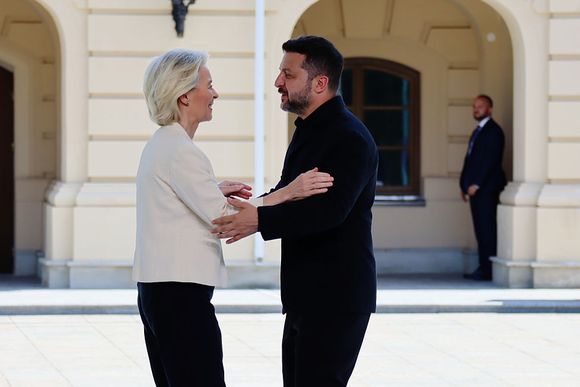
Ursula von der Leyen and Volodymyr Zelenskyy [Andriy Zhyhaylo via Getty Images]

The EU is considering paying out most of next year’s loan to Ukraine in the opening months of 2027, according to senior officials and diplomats, as Kyiv faces a widening funding gap.

The European Commission is examining whether to accelerate disbursement of much of the €45 billion earmarked for 2027 under the EU’s €90 billion loan. That money is currently due to be paid throughout the year.

Kyiv projects a €23.5 billion shortfall this year and a further €28.4 billion gap in 2027. Intensified Russian attacks on Ukrainian industry are squeezing the tax revenues that help fund the state.

EU governments had pushed to bring some of the 2027 funding forward into this year. The option now under consideration would instead concentrate payments in early 2027. That could ease pressure on Kyiv at the start of next year, but would not fill this year’s gap or increase the total available.

Brussels’ €90 billion loan was designed to cover two-thirds of Kyiv’s estimated needs in 2026 and 2027, leaving other partners to provide about €45 billion. They had committed around €15 billion by March.

Norway has since proposed about €7.9 billion in military and civilian support for 2027, but an updated total of commitments from other partners has yet to emerge.

"It is clear that Ukraine is running out of money more quickly than we thought," Philipp Lausberg, a senior policy analyst at the European Policy Centre, told Rapporteur.

How much of Kyiv’s revised shortfall the funding will cover, and when it will arrive, remains unclear. So far, contributions from other partners look unlikely to meet the EU’s expectations or Ukraine’s growing needs.

Read the full story.

Can social media predict the next Ceuta?

European home affairs ministers will be explicitly asked at a meeting next week whether EU migration agencies should be given a role in monitoring social media for signs of sudden migration flows, according to an internal Council document seen by my colleague Nicoletta Ionta.

The Commission is considering wider powers for Frontex and Europol after a surge in arrivals to Ceuta, the Spanish North African enclave, in July exposed gaps in the bloc’s migration early-warning system. The EU executive is expected to propose a revised Frontex mandate in October.

The agencies could be tasked with tracking broad social media trends, online narratives and suspected smuggling networks. Any expansion of their powers would have to address their legal mandates and data-protection rules.

Red tape won’t cut itself

Valdis Dombrovskis told my colleague Thomas Møller-Nielsen that national officials have slowed the Commission’s push to “simplify” EU rules, despite broad political support among ministers for easing the regulatory burden on companies.

“If you talk with ministers, with few exceptions, they want simplification,” the EU economy commissioner said. “National positions are not drafted by prime ministers or ministers” but by specialists who may resist changes in their own fields, he argued.

“We need constant political attention to this. And clearly, this will require a top-down approach. Bureaucracy will not reduce itself.” Read the full interview.

MEPs press VDL over fur ban

MEPs from across the political spectrum are pressing the Commission to respond to the “Fur Free Europe” citizens’ initiative.

In two letters obtained by my colleagues Alice Bergoënd and Sofia Sanchez Manzanaro, lawmakers call for a bloc-wide ban on fur farming. They warn that the European Parliament is unlikely to accept the alternative under consideration: tighter welfare standards that would leave fur farming in place.

"The Commission has got an opportunity to correct its negligence towards animals and their suffering, and negligence towards what 1.5 million European citizens have been calling for,” said Martin Hojsík, the MEP who organised one of the letters.

The Commission had promised a response by March. Six months on, a decision remains stalled amid disagreements between von der Leyen’s office and that of Health and Animal Welfare Commissioner Olivér Várhelyi, diplomats told Alice and Sofia. Read their full report.

Here are three new stories from Euractiv:

Advertisement
Lockheed Martin
 

EU SINK?: Trade unions will demonstrate outside the Council building today against “EU Inc,” a proposal for an EU-wide framework for setting up companies. They want to “fix or sink” the project, which they fear could endanger workers’ rights.


WARSAW 🇵🇱

A Russian Mi-8 helicopter crossed about 300 metres into Polish airspace near Braniewo, remaining there for 42 seconds, Poland’s military said. Fighter jets were scrambled and ground forces put on alert as the aircraft flew from Russia’s Kaliningrad exclave. Poland’s Operational Command said the incursion appeared to be another attempt by Moscow to test its air defences.

– Charles Szumski

LONDON 🇬🇧

PM Andy Burnham met Ursula von der Leyen on the sidelines of the UN General Assembly to discuss economic ties, migration, Russia and AI. London pressed Brussels to include British companies in its planned “Made in Europe” industrial rules, arguing that the UK should be treated as a trusted partner. The issue is shaping up to be a test of the UK-EU reset ahead of their next summit.

– Charles Szumski

BERLIN 🇩🇪

Friedrich Merz’s CDU has raised the prospect of intelligence monitoring of Berlin’s Left party, citing alleged links to organised crime and antisemitic incidents. Alexander Throm, the CDU/CSU’s interior affairs spokesperson in the Bundestag, called for a “serious” review of whether the party’s Berlin branch warranted scrutiny by the domestic intelligence service. The Left won 25.7% in Sunday’s Berlin election, pushing the CDU into second place.

– Victoria Becker

BUCHAREST 🇷🇴

Romania’s parliament will “most likely” vote next Tuesday on a proposed government led by PM-designate Siegfried Mureșan, he said. Seeking Social Democrat support, Mureșan pledged some pension and salary increases while ruling out tax hikes. His National Liberal Party and two smaller parties back the proposed cabinet, but they lack a parliamentary majority. President Nicușor Dan nominated him earlier this month.

– Matei Rosca

MADRID 🇪🇸

Former Spanish PM José Luis Rodríguez Zapatero said in a written submission to a judge that jewellery seized from his office was a gift from Saudi Arabia’s then king in 2007. The pieces were valued at €1.3 million by an expert appointed by the court, a valuation Zapatero disputes. The jewellery is being examined in an investigation into possible tax and smuggling offences arising from the wider Plus Ultra airline bailout case.

– Inés Fernández-Pontes

SOFIA 🇧🇬

Bulgaria’s parliament voted 121-42 to lift a year-long ban on exports of diesel, kerosene and other petroleum products to EU countries, saying it breached single-market rules after US and UK sanctions on Lukoil’s Burgas refinery were eased. The ruling left-wing Progressive Bulgaria backed the repeal, while the centre-right GERB-SDS was divided and the ethnic-Turkish liberal DPS did not vote. The refinery had accumulated around 50,000 tonnes of unsold diesel, worth roughly $73 million.

– Konstantin Karadjov

NICOSIA 🇨🇾

Turkish forces tried to stop Greek Cypriot farmers ploughing fields in the UN buffer zone near Deneia, before UN personnel intervened and allowed work to continue. The farmers are permitted to cultivate designated plots with UN approval. The confrontation follows several similar incidents in recent months, as hopes grow for a resumption of UN-backed talks on reunifying Cyprus.

– Sarantis Michalopoulos

 

Politics Reporter
Magnus Lund Nielsen
Politics Editor
Bruno Waterfield
 

Contributors: Nicoletta Ionta, Sofia Sanchez Manzanaro, Alice Bergoënd, Maximilian Henning, Thomas Moller-Nielsen

Editors: Christina Zhao, Sofia Mandilara, Charles Szumski

Euractiv
Euractiv Media BV - Boulevard Charlemagne 1, Brussels 1041 - Belgium
Copyright © 2026. All rights reserved.