In Monday's edition: Ukraine, Döpfner’s U-turn, Trump’s assets plan, Kyuchyuk, Mercosur
Rapporteur
Powered by

Welcome to Monday's Rapporteur. This is Eddy Wax in Brussels, with Nicoletta Ionta.

Send us your tips, documents and story ideas: eddy.wax@euractiv.com and nicoletta.ionta@euractiv.com

Need-to-knows:

🟢 Momentum grows for alternatives to Ukraine reparations loan

🟢 Parliament’s top legal affairs MEP is in... legal trouble

🟢 France calls for delay to Mercosur

Powered by S&D

Meet the Socialists and Democrats from across Europe — the people turning your priorities into action. Find the MEPs representing your country and watch how they work every day to defend your rights, strengthen democracy, and build a fairer Europe. Find out more.

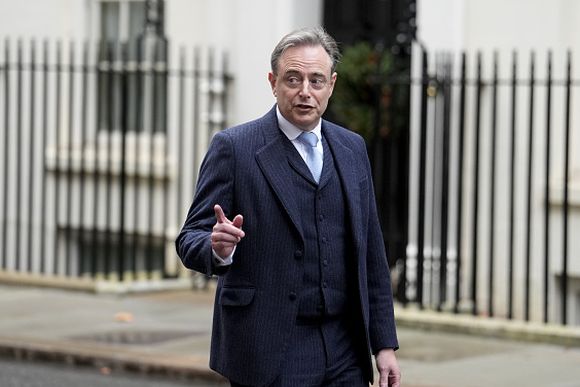
Bart De Wever (Photo by Jordan Pettitt/PA Images via Getty Images)

On foreign policy, EU officials cite the need to be not just a payer but a player. On Ukraine, it’s looking like they’ll be neither.

After months of stubborn infighting and bitter briefings, Thursday’s meeting of EU leaders in Brussels heralds a decisive showdown between Belgian Prime Minister Bart De Wever and his EU allies over a reparations loan designed to allow Ukraine to use Russian assets to keep resisting, and to force Vladimir Putin to the table.

For proponents, such as Friedrich Merz and Ursula von der Leyen, it also comes at an awkward time. The US is intensifying diplomatic efforts to end the war this year, pressing Volodymyr Zelenskyy to accept painful compromises. Merz is holding talks in Berlin today with Zelenskyy and US envoy Steve Witkoff, with von der Leyen also in attendance.

What's at stake goes beyond Ukraine’s short-term financing needs. The dispute reflects two radically different strategies to end the war: Brussels’ plan to make Kyiv a “steel porcupine,” able to deter Russia militarily, versus Washington’s priority to “stop the killing” – even if that means territorial concessions by Kyiv. (We have more below on what Trump is planning to do with the assets.)

At this crunch moment, the EU’s loan plan for Ukraine is failing as MAGA-friendly governments swing behind Belgium.
Italy and Bulgaria joined Belgium last week in calling for “alternative options” to keep Kyiv financially armed. (So did left-wing Malta).

The new Czech PM, Andrej Babiš – a Trump super-fan – announced on Saturday that he was dead against the reparations loan, ruling out providing any guarantees to Belgium. On Friday Slovakia’s Robert Fico warned that using the assets “could directly jeopardise US peace efforts,” arguing that the Americans want to use the money for post-war reconstruction.

If opposition hardens, António Costa will face a major decision on Thursday: give up or ram the scheme through. Either course risks political damage – and, potentially, a fracture in the bloc’s fragile Ukraine unity.

So, what about those alternatives? As my colleague Thomas Møller-Nielsen noted in his
Econ Brief newsletter, the fundamental problem is that the EU wants to keep supporting Ukraine without spending much of its own money.

For more than two months, De Wever has come under heavy fire for his painstaking arguments that using Russian assets is financially risky, legally dubious, harmful to peace, bad for reconstructing Ukraine, and even an
act of war.

Yet Merz, the main pusher of this scheme, has made little public effort to explain why the Commission's fallback option – joint debt – is a worse idea. Yes, I hear you say, Viktor Orbán would block it. But the EU has found ways to apply pressure on Hungary before – for example, in rolling over Russia sanctions every six months. Merz has a lot of leverage due to German carmakers’ investments in Hungary.

The deeper issue is that the Commission has never seriously
contemplated a second option, and national leaders, already cowed by Trump, have avoided making the tough case for paying for Ukraine directly out of stretched national coffers. That stubbornness could be the perfect excuse for Trump to impose a MAGA-style peace on Ukraine.

Speaking of which...

Trump’s alternative

Talks between the US and Ukrainian officials in Miami earlier this month explored the creation of a US-Russia reconstruction fund for Ukraine, with the EU relegated to the role of contributor, a person familiar with the discussions told Chief Correspondent Sarantis Michalopoulos.

Under a draft document seen by the source, Russian sovereign assets would be placed into the fund, with the EU expected to contribute €100 billion. Washington and Moscow would jointly “decide the destiny of Russian assets,” the source said. The Zaporizhzhia nuclear power plant, currently under Russian control, would be co-owned by the US and Russia.

The plan also envisaged demilitarised or buffer zones sought by Kyiv being granted forms of local “self-governance.” Full control of Donetsk, where Russia currently holds about 70% of the territory and Ukraine 30%, would pass to Moscow.

The document further included a provision for Ukraine to join the EU by 1  January 2027 – a goal that also features in a revised proposal submitted by Zelenskyy to the White House.

France hits the Mercosur brakes

France
wants to delay a vote scheduled this week on the EU-South America trade deal, its PM said last night. Von der Leyen had planned to sign the agreement on 20 December in Brazil, but Paris has been pushing for more guarantees and safeguards for its farmers.

The vote, due to take place in the Council of the EU, requires only a qualified majority of countries to authorise von der Leyen’s trip. Whether it will now proceed remains unclear. Even if it does, passage is not assured. Italy, whose position is still open, could yet prove pivotal.

The EU’s ambition to finalise two major agreements by the year’s end – Mercosur and a free trade deal with India – are looking increasingly fragile, my colleague Sofía Sánchez Manzanaro writes. Her
full analysis is worth reading.

Döpfner’s Trump recalibration

Mathias Döpfner, the German media tycoon who controls America’s Politico as well as Bild and Die Welt via Axel Springer, has a habit of ideological reinvention.

After Trump’s Oval Office ambush of Zelenskyy in March, Döpfner published a striking commentary warning that the “world order is teetering” and that the US government is crossing democratic red lines “almost by the hour.” Coming from a man who once urged aides to “pray” for a Trump victory, it sounded like a genuine reckoning.

It did not last.

In a new column published over the weekend in Politico and Welt, Döpfner argued that Europeans have misread Trump entirely. “Trump wants a strong Europe – and Europe should listen,” he wrote, accusing the continent of being thin-skinned and “incapable of accepting criticism.”

The rhetorical flourish peaks with a lament about the “castration of thought through a language of evasions,” deployed in defence of a US president whose movement openly seeks to weaken the EU – an institution Axel Springer once championed. (If that sounds a bit Freudian, see the latest
Chattering Classes for an explanation.)

A cynic might see less philosophy than positioning. Trump remains openly hostile to Politico, recently calling it “extremely unfriendly” even while accepting its “Man for Europe” award.

Winning him over may yet require further conversations. Fortunately, Döpfner has shown a willingness to adapt.

College shrugs off Mogherini’s resignation

Herman Van Rompuy sought to downplay the scandal that engulfed the College of Europe at an internal meeting he chaired on Friday, two sources told Rapporteur and Magnus Lund Nielsen.

Van Rompuy, president of the institution’s highest decision-making body, told staff and diplomats that the College itself was not under investigation and said he would become more involved in coming months – a claim contradicted by a
statement from the European Public Prosecutor’s Office.

Some European diplomats questioned whether the College had assessed the potential financial impact of the affair. Federica Mogherini stepped down as rector last week amid a corruption scandal and has been replaced on an interim basis by
her deputy until June.

Hungary has since refused to approve the school’s next annual budget, a move that’s been described as largely symbolic.

Explainer: The EU’s asylum rewrite

The EU is overhauling its migration system through several laws that will redefine how asylum claims are registered, processed, and allocated, Nicoletta writes in her piece today.

Supporters say the reforms will bring greater efficiency and predictability to an overstretched system. Human rights advocates, however, warn that the changes could weaken safeguards for asylum seekers. All that you need to know about what has been approved, and what remains on the agenda is
here.

Immunity chief faces immunity waiver

The chair of Parliament’s Legal Affairs Committee is now facing the very procedure he is responsible for overseeing.

Bulgarian authorities have asked Parliament to lift the immunity of Renew MEP Ilhan Kyuchyuk, three officials familiar with the matter told Rapporteur. The request, which stems from a complaint filed by one of Kyuchyuk’s local assistants, is expected to be announced in plenary this week.

Kyuchyuk has denied the allegations and said he will not step down, in comments to Rapporteur. To avoid any appearance of a conflict of interest, he said he would recuse himself from all procedural oversight of his own case, temporarily handing the gavel to a vice-chair.

PARIS 🇫🇷

Farmers have blocked several major routes in southern France since Friday, including the motorway linking Toulouse and Bayonne, in protest at the government’s decision to cull cattle herds affected by lumpy skin disease. The action has been led by Coordination Rurale, a far-right farmers’ union, which has
warned of the risk of “civil war.” Olivier Debaere, crisis director at France’s agriculture ministry, said the cull was “a terrible but necessary measure” to prevent the disease spreading to other herds.

Laurent Geslin

ROME 🇮🇹

Giorgia Meloni on Sunday dismissed what she called “overly alarmist” reactions to Trump’s renewed warnings that the US could scale back its role in Europe’s defence. Speaking at her Brothers of Italy party’s annual festival in Rome, Meloni framed Trump’s message as a long-overdue wake-up call. Europe, she argued, had spent decades outsourcing its security to Washington, a dependence that came at the cost of political “conditioning” and what she called a “comfortable servitude.”

Alessia Peretti

MADRID 🇪🇸

A court has provisionally
released former Socialist official Leire Díez, ex-SEPI president Vicente Fernández, and businessman Antxon Alonso under precautionary measures, days after their arrest in the so-called Koldo corruption probe. The arrests, carried out on Wednesday, form part of a wider investigation into the alleged manipulation of public contracts, including five deals linked to the state holding company SEPI worth €132 million. In a further blow to Pedro Sánchez’s fragile coalition, Spain’s Civil Guard also searched the finance and energy ministries, as well as the postal service Correos, for evidence.

Inés Fernández-Pontes

WARSAW 🇵🇱

Foreign Minister Radosław Sikorski
said on Sunday that President Karol Nawrocki’s office had been involved in talks on the possible transfer of MiG-29 fighter jets to Ukraine, countering claims from the presidential chancellery. For several days, Nawrocki’s office has insisted the president was not informed of the government’s plan, announced last week. Sikorski added that the government had previously worked “productively” with Nawrocki’s pro-Ukrainian predecessor, Andrzej Duda, whom he succeeded in August.

Aleksandra Krzysztoszek

THE HAGUE 🇳🇱

Dutch police arrested 22 people after clashes with protesters outside Amsterdam’s Concertgebouw on Sunday, where Israel’s military chief cantor, Shai Abramson, was due to perform. Riot police used batons after demonstrators set off smoke bombs, with one officer injured. Abramson’s planned public Hanukkah appearance was cancelled amid outcry over his military ties and replaced with two private evening concerts, against the backdrop of a fragile Gaza ceasefire.

Christina Zhao

The TAO of Stevin: Thousands of EU officials have signed a petition questioning their exclusion from an ongoing review that could lead to deep reforms of the European Commission. “We will not accept being sidelined from any possible changes concerning our future,” the staff union TAO wrote in a letter to Commissioner Piotr Serafin, seen by Rapporteur. Staffers are worried about sneaky changes to their working conditions ahead of expected cuts to the EU’s long-term budget.

Advertisement
S&D Newsletter

For years, European policymakers have waited for China’s consumers to save global trade balances. In an op-ed for Euractiv, Elaine Dezenski, head of the FDD’s Center on Economic and Financial Power, argues that moment is not coming.

Instead, she writes, Beijing has locked in an export-first strategy – suppressing wages, subsidising production and sending waves of cheap goods into Europe. The result is a slow erosion of Western manufacturing, met with too little urgency in Brussels.

author_name Newsletter Editor
Eddy Wax
author_name Politics Reporter
Nicoletta Ionta

Contributors: Thomas Møller-Nielsen, Sarantis Michalopoulos, Nikolaus J. Kurmayer, Aurélie Pugnet, Magnus Lund Nielsen, Sofia Manzanaro

Editors: Christina Zhao, Sofia Mandilara

Euractiv
Subscribe
Euractiv Media BV - Boulevard Charlemagne 1, Brussels 1041 - Belgium
Copyright © 2025. All rights reserved.