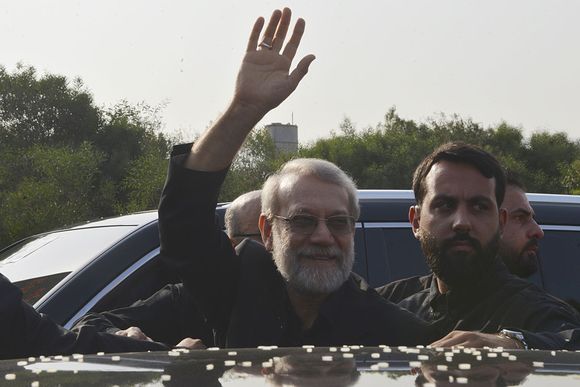
A series of reported precision strikes in Tehran has fuelled intense speculation about the resilience of Iran’s political and security establishment.
The deaths of Ali Larijani, a longtime fixture of the Islamic Republic’s political elite, and Gholamreza Soleimani, head of the Basij paramilitary, if verified, would mark one of the most consequential blows to the system in recent years.
Even in a region accustomed to sudden escalations, the simultaneous removal of figures tied to both coercive power and political co-ordination would underscore the erosion of the regime’s long-cultivated image of internal control.
Particular weight falls on Soleimani. Reports indicate he was killed alongside his deputy and around ten other senior Basij commanders – a concentration of leadership that suggests disruption extending beyond a single figure. As head of a force central to policing dissent, he had come to embody the regime’s capacity to project coercive power deep into society.
Larijani, by contrast, has long operated at the intersection of governance and strategy. A former speaker of parliament and a confidant within Iran’s conservative establishment, he has often served as a bridge among competing factions. His influence extended beyond formal titles, shaping consensus in moments of internal disagreement. He was considered by many to be the most powerful force within the regime following the killing of Ayatollah Ali Khamenei, Iran’s longtime supreme leader, on the first day of the war.
Their respective roles – one grounded in enforcement, the other in elite co-ordination – illustrate how authority in Iran is distributed across parallel institutions rather than concentrated in a single office.
Whether these reported deaths translate into lasting structural disruption remains uncertain. Iran’s system has historically demonstrated an ability to absorb shocks, replacing individuals while preserving institutional continuity. Leadership networks within both the Basij and the broader political class are layered, with successors often groomed well in advance.
Still, the symbolic impact could be harder to contain. Targeting figures embedded in Tehran, rather than in peripheral theatres of conflict, challenges assumptions about the regime’s internal security perimetre. It may also heighten perceptions of vulnerability among elites who have long operated under an implicit sense of protection within the capital.
The timing may add a further layer of significance. The strikes coincide with Chaharshanbe Suri, the fire festivities taking place across Iranian cities – events that, beyond their cultural roots, have in recent years provided moments for visible public expression. Any perception that the regime’s security leadership is vulnerable at the centre could sharpen the atmosphere surrounding such gatherings.
Seen in a broader strategic context, such strikes would also represent a substantial step forward in the US-Israeli effort to destabilise the Islamic Republic. Rather than focusing solely on Iran’s regional proxies or external military assets, operations of this kind appear aimed at exposing weaknesses at the centre of the system itself – unsettling elite confidence, deepening mistrust within the security establishment and forcing Tehran to divert attention towards internal defence. In that sense, the significance lies not only in the individuals reportedly targeted, but in the suggestion that the regime’s core networks are increasingly penetrable.
If confirmed, the loss of a figure like Larijani could complicate already delicate factional balances. Iran’s political system relies on negotiated alignments among conservatives, hard-liners and pragmatic actors. Removing a seasoned intermediary risks amplifying rivalries at a time when the future of the regime is hanging in the balance.
On the security side, disruption within the Basij command will add further uncertainty after days of targeted US-Israeli attacks on the core infrastructure of Iran’s internal law enforcement apparatus.
More than an immediate collapse, the assassinations – if borne out – may represent a shift in perception. For decades, the Islamic Republic has projected durability rooted in both coercion and political management. Demonstrating again that senior figures are not beyond reach could alter calculations both inside and outside the country.
Whether that perception translates into tangible change will depend less on the removal of individuals than on how effectively the system adapts – and, above all, on the response of Iranian society in the days ahead.
|