Also, Order of Merit, Turnberry, jet fuel
Rapporteur

You’re reading Rapporteur on Tuesday 19 May. Eddy Wax here in Strasbourg (say hi), with Nicoletta Ionta in Brussels.

Need-to-knows:

🟢 Von der Leyen to honour political mentor

🟢 Fresh attempts to clinch Trump trade deal

🟢 Weeks till jet fuel shortages become acute

Advertisement
EuractivPRO

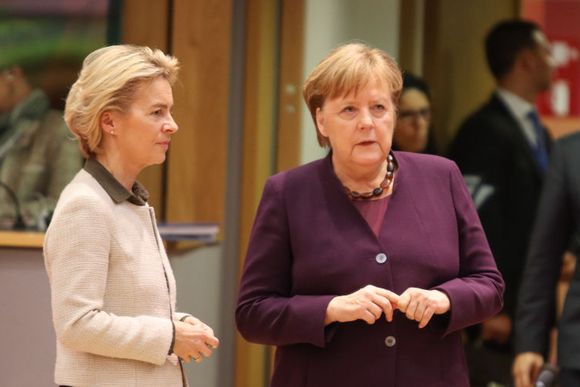
Ursula von der Leyen and Angela Merkel (Photo by Nicolas Economou/NurPhoto via Getty Images)

In what must be the peak of her lacklustre post-political career so far, Angela Merkel will today become a ‘distinguished member’ of the European Order of Merit, a new prize devised by MEPs.

At a suitably grand ceremony in Strasbourg, Merkel may have a chance to exchange a few words with one of her protégés as Ursula von der Leyen personally places the medal around her neck.

The former chancellor, once dubbed the Queen of Europe, might even offer advice on how to weather an unflattering reassessment of one’s political legacy. Merkel’s reputation, particularly her conciliatory approach towards Russia and opposition to Ukraine joining NATO in 2008, has come under sustained scrutiny since Vladimir Putin’s full-scale invasion in 2022.

On Monday, she – with some gall – called on EU leaders to speak directly to Moscow over ending the war.

Like her mentor, von der Leyen is also undergoing a reappraisal of her first term as Commission president. Rather than being remembered primarily as the architect of the Green Deal, she increasingly faces questions over Europe’s weak industrial and economic footing despite her sweeping centralisation of power within Brussels.

She spent 14 years serving in Merkel’s cabinets – first as family minister, then labour minister, before moving to defence. Von der Leyen has spoken warmly of the “joy and cordiality” between them and was even caught on a hot mic last year boasting about being Merkel’s longest-serving minister while walking through Brussels’ Justus Lipsius building with Donald Tusk.

In reality, however, the relationship was characterised by strategic loyalty on the part of von der Leyen. Merkel was not always her best friend, twice overlooking her for the German presidency. And earlier this year, von der Leyen publicly broke with Merkel’s anti-nuclear legacy, describing Germany’s exit from nuclear power as a “strategic mistake.”

Von der Leyen also watched Merkel steer a grand coalition and learned. Both women are often seen less as ideological politicians than as highly adaptable politicians, capable of aerobatics and shapeshifting to political realities.

Yet they emerged from very different worlds. Merkel, a self-made chancellor from East Germany, built herself into the CDU’s dominant political force. Von der Leyen, née Albrecht, was born into a West German political dynasty and has largely eschewed party politics.

To understand von der Leyen’s political instincts, look no further than her Merkelian array of speechwriters, encompassing Greens, Socialists and soft conservatives. Of the five, one is the former right-hand man of Robert Habeck, one a former assistant to the socialist group in the European Parliament, and another a Fine Gael spin doctor.

As Merkel found, holding together a broad political coalition often becomes an exercise in day-to-day survival rather than long-term strategic direction. Another discomforting part of Merkel’s legacy is the rise of the far-right Alternative for Germany.

Von der Leyen spoke out squarely against the far-right in 2024 when seeking re-election. But two years on, her Democracy Shield doesn’t seem to be doing much to slow the pan-European trend.

Bernd Lange’s last hill

EU negotiators will reconvene tonight in Strasbourg – perhaps for a final time – to reach a common position on the US trade deal, according to Sofía Sánchez Manzanaro.

As usual, Washington has been pressuring Brussels to get it over with, accusing the EU of slow-walking tariff cuts and warning MEPs led by social democrat Bernd Lange not to “rewrite the deal.”

The EU did drag its feet, especially in January, when the US was threatening to annex Greenland. It’s ironic – and a little bleak – that nothing seems to have changed since then. Just listen to the Greenlandic PM, who said on Monday that Washington’s designs on the island have not changed.

For some, though, this has gone on long enough. EPP rapporteur Željana Zovko urged lawmakers to “step beyond red lines that risk undermining the agreement itself.” But Socialists, liberals and Greens are still fighting to keep at least some strings attached, allowing the EU to retaliate should Trump impose fresh tariffs that breach the deal (like he already has).

A hard-line sunrise clause – which would make tariff relief conditional on the US first lifting steel duties – appears dead after pushback from capitals. But negotiators are discussing a softer fallback clause tied to Washington meeting its commitments, according to sources familiar with the talks. One safeguard is already locked in: a mechanism allowing the EU to act if a surge in US imports harms European producers.

The Parliament also wants the deal to expire by March 2028 under a sunset clause. Governments are not opposed in principle, but would prefer the agreement to lapse after the Trump administration leaves office. Diplomats told Euractiv that a mid-2029 expiry date is now under consideration.

Europe’s MAGA man

Karol Nawrocki, Poland’s president, is positioning himself as Europe’s foremost MAGA-aligned leader – pairing close ties to Donald Trump with a hardline conservative agenda – even as parts of Europe’s nationalist right begin to distance themselves from the US president.

Nawrocki’s camp has largely avoided publicly criticising Trump, a notable contrast with other far-right leaders who have recently shown greater willingness to challenge Washington openly amid growing unease over his rhetoric and foreign policy, including Giorgia Meloni and Germany’s AfD. Read the full story by Karolina Wójcicka.

Armed neutrality

Vienna has spent years arguing that military neutrality and meaningful participation in European security are not mutually exclusive. But that balancing act is becoming harder to sustain as Russia’s war in Ukraine drags on and cracks widen across the Atlantic alliance.

The goal, Defence Minister Klaudia Tanner told Björn Stritzel in an interview, is to remain “militarily neutral, on the one hand, while at the same time remaining a credible partner within the framework of the Common Security and Defence Policy.” Read the full interview.

Weeks before jet fuel crunch

EU fuel supplies, particularly for aviation, could face “regional supply constraints” if the Strait of Hormuz isn’t re-opened “in the next weeks,” the European Commission said after a meeting with national and international oil experts on Monday.

The EU executive said “fuel-saving measures” may be required if the bloc releases emergency fuel stocks, to ensure supplies last longer.

The Commission, which has long downplayed the impact of the Middle East war on fuel availability in Europe, repeated that “there are no shortages of fuel in the EU at present.” It added that it would continue to monitor the situation and “support coordinated action as needed.”

Here are 4 new stories in Euractiv:

MACRON’S UNLIKELY FAN: Speaking to students in Slovakia on Saturday, Robert Fico said Emmanuel Macron was the only European leader capable of steering the continent after he leaves office in 2027. Fico – otherwise something of a political pariah in much of Europe who recently visited Russia and met Vladimir Putin – praised the French centrist as “someone who has a vision” and knows “what Europe needs to do in order to survive."

PRIDE CLASH: ECR MEP Geadis Geadi circulated an email accusing the Commission of breaching “institutional neutrality” by displaying the Pride ​flag. The EPP’s Ondřej Kolář shot back, arguing the real problem was politicians waging “absurd cultural wars” against gay people.

SOFIA 🇧🇬

PM Rumen Radev used his first foreign trip since taking office to deepen defence ties with Germany, pitching joint arms production and warning that Europe’s war footing cannot come at the expense of cohesion funds. Standing alongside Friedrich Merz in Berlin, Radev also called for urgent diplomacy on Ukraine, while the German chancellor insisted Moscow must first stop striking civilians. Read the full story.

Konstantin Karadjov

BERLIN 🇩🇪

Angela Merkel urged EU leaders to engage directly with Russia to help end the war in Ukraine, lamenting what she described as Europe’s underused diplomatic clout. Speaking at an event in Berlin, the former German chancellor rejected suggestions she could mediate between Brussels and Moscow, saying only sitting European leaders would be “taken seriously” by Vladimir Putin. Read the full story.

Thomas Møller-Nielsen

PARIS 🇫🇷

Justice Minister Gérald Darmanin travelled to Algiers on Monday for a 24-hour visit aimed at repairing relations strained by nearly two years of tensions between France and Algeria. Accompanied by senior judicial officials, including national financial prosecutor Pascal Prache, Darmanin discussed colonial-era assets, detained French journalist Christophe Gleizes and cooperation against the Marseille-based Algerian criminal network known as the “DZ Mafia.”

Clara Vassent

ROME 🇮🇹

Giorgia Meloni has threatened to pull Italy out of the EU’s €150 billion SAFE rearmament programme unless Brussels extends fiscal “escape clause” measures to cover energy crisis spending. In a letter to Ursula von der Leyen seen by Euractiv, the Italian prime minister argued the bloc could not justify loosening spending rules for defence while denying flexibility to shield households and businesses from surging energy costs. Read the full story.

Pietro Guastamacchia

VIENNA 🇦🇹

Austria’s government plans to introduce a “package tax” targeting large online retailers such as Amazon and Temu. Under the proposal, companies generating at least €100 million in annual online sales in Austria would charge customers €2 per shipment. Officials argue the platforms create relatively little domestic added value and say the measure could raise €280 million a year while supporting bricks-and-mortar retailers and environmental goals.

Jakob Ploteny

ATHENS 🇬🇷

Former PM Alexis Tsipras is set to launch a new political party on 26 May, a move that could reshape the country’s centre-left ahead of the 2027 elections. Tsipras had reportedly planned to unveil the party in September but brought forward the launch amid mounting speculation over possible snap elections. Recent polling suggests a Tsipras-led movement could rival PASOK for second place nationally.

Sarantis Michalopoulos

MOSCOW 🇷🇺

Vladimir Putin will travel to Beijing on 19-20 May for talks with Chinese President Xi Jinping focused on energy cooperation, including the proposed Power of Siberia 2 gas pipeline, Kremlin aide Yury Ushakov said on Monday. Ushakov denied the visit was linked to Donald Trump’s recent China trip. Moscow said around 40 bilateral agreements would be signed, alongside discussions on a “multipolar world order.”

Charles Szumski

Eddy Wax Newsletter Editor
Eddy Wax
Nicoletta Ionta Politics Reporter
Nicoletta Ionta

Contributors: Sofia Sanchez Manzanaro, Björn Stritzel, Magnus Lund Nielsen, Stefano Porciello

Editors: Christina Zhao, Sofia Mandilara, Charles Szumski

Euractiv
Euractiv Media BV - Boulevard Charlemagne 1, Brussels 1041 - Belgium
Copyright © 2026. All rights reserved.