Also, free roaming, Péter Magyar, and Huawei
Rapporteur

You’re reading Rapporteur on Thursday 4 June. This is Nicoletta Ionta en route to Luxembourg, joined by Eddy Wax in Brussels.

Need-to-knows:

🟢 France wants to make Channel crossings an EU issue

🟢 Brussels offers roaming as a sweetener for the Balkans

🟢 Parliament vice president’s exit boosts liberals before midterms

On the roundabout: An AfD lawmaker’s spat with Armenia

Advertisement
Rapporteur ES

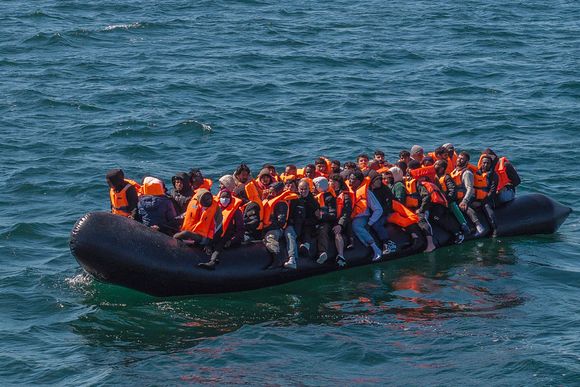
An inflatable 'small boat' carrying migrants crosses the channel (Photo by Dan Kitwood via Getty Images)

On a beach in Gravelines, northern France, the wind whipped against my face.

Just behind the scrubland lies one of Europe’s most politically charged migration routes. From this stretch of coastline, where England feels tantalisingly close, small boats launch towards the UK carrying people hoping to cross the Channel.

When I visited last month, authorities were dismantling Calais’ main makeshift camp. The operations had become a weekly occurrence, sometimes more frequent. Helicopters thudded overhead as people carried away what remained of their belongings across a landscape of empty fields and deserted roads.

The small-boat crossings have long haunted both British and French politics, becoming a symbol of governments struggling to control migration.

The numbers, however, are falling. Between 1 January and 25 May 2026, 8,565 people crossed the Channel in small boats, down 37% on the same period last year.

But politically the issue remains as potent as ever. The question is now whether the Channel can be transformed from a Franco-British issue into a European one.

The issue lands on EU home affairs ministers’ desks in Luxembourg today as the Commission prepares to unveil an action plan on the Channel route later this month. The EU executive is expected to give ministers a first glimpse of the proposals, though expectations remain modest.

Paris is pushing for the crossings to be treated as an EU-UK matter rather than a largely French responsibility. Many capitals remain unconvinced, diplomats told me.

The plan is likely to focus on tighter border controls, action against smuggling networks and greater mobilisation of EU agencies. Whether it will come with fresh funding remains unclear. There’s little appetite for new financial commitments, while proposals touching on migration readmission remain a non-starter for several Mediterranean countries.

Last year, Italy, Spain, Cyprus and Greece warned the Commission against a new UK-France “one-in, one-out” arrangement under which Britain could return small-boat arrivals to France in exchange for accepting an equal number of asylum seekers with ties to the UK.

Those countries feared the arrangement could ultimately leave them responsible for migrants returned from Britain to Europe. The deal was extended last month.

In some ways, it worked too well. The geography of the crossings is beginning to shift. Migrants are increasingly trying to depart from the Belgian coast, despite the journey being longer and more dangerous.

That could help Paris convince other capitals that the Channel is becoming an EU problem rather than simply a French one.

EU offers Balkans a sweetener

The EU can’t promise to speed up the accession of countries such as North Macedonia, Bosnia and Herzegovina or Albania. It can, however, make it cheaper for their citizens to use mobile phones across the bloc.

Ministers are expected to give the green light today to launch negotiations on free roaming. That’s the sweetener EU leaders will bring to Tivat, Montenegro, for an enlargement summit on Friday.

Read Théophane Hartmann and Eddy’s full story.

Magyar's key condition for Ukraine’s EU membership

Péter Magyar announced last night that he had reached a deal with Ukraine on protecting the rights of the Hungarian minority in Transcarpathia.

It means that, as we previously reported, Ukraine’s first formal accession negotiations can begin in mid-June. The development is being celebrated in Brussels and across EU capitals – but how long will the goodwill last?

Buried at the end of Magyar’s statement was a sentence that should give pause to ministers cheering from the sidelines. “If Ukraine succeeds in closing all 33 accession chapters within the next 10 to 15 years, Hungary will support Ukraine’s accession, subject to a legally binding referendum,” Magyar wrote.

Vice president departure shakes midterm arithmetic

European Parliament Vice President Pina Picierno is set to leave the Democratic Party and its Socialist group affiliation in a move that could strengthen the liberals ahead of next year’s midterm reshuffle, when Parliament’s political groups will renegotiate top jobs.

Picierno announced her departure in an interview with Italian newspaper Il Foglio. Parliamentary sources told Rapporteur she is considering a move to Renew Europe – which has recently attracted new members. If confirmed, she would become the second MEP to leave the Socialists in recent months.

One of the Parliament’s most outspoken supporters of Ukraine, Picierno has increasingly clashed with Italy’s Democratic Party leader Elly Schlein over foreign policy, as well as the party’s stance on security and defence. Her departure has been the subject of speculation for months.

The Italian job

ECR’s Italians rode to the rescue of two EPP compatriots caught up in the Huawei lobbying probe.

EPP MEPs Fulvio Martusciello and Salvatore De Meo faced votes in the European Parliament’s legal affairs committee on requests from Belgian authorities to lift their parliamentary immunity as part of a criminal investigation into alleged lobbying linked to Huawei in Brussels. Both deny wrongdoing.

According to three officials, several ECR members of the committee were replaced by Italian colleagues shortly before the vote in a move intended to help shield the two MEPs. The EPP and ECR are coalition partners in Giorgia Meloni’s government.

The gambit only partly succeeded. MEPs backed lifting the immunity of Martusciello, while a separate request concerning De Meo failed to secure enough backing.

Lifting parliamentary immunity does not imply guilt but allows judicial authorities to pursue investigative steps.

An ECR spokesperson told Rapporteur that committee substitutions are “a normal and well-established parliamentary practice” and cautioned against drawing conclusions about voting behaviour.

Denmark ditches farm minister

Denmark has become the only EU country without a dedicated agriculture minister after Mette Frederiksen’s new centre-left government abolished the post and replaced it with a minister for nature and animal welfare.

The move, aimed in part at Denmark’s politically contentious pig industry, was hailed by animal welfare groups as historic. Farmers were less impressed. Renew MEP and farmer Asger Christensen called the decision a “disaster," warning that "when several people are responsible, nobody is responsible" as agricultural duties are split across five ministries. Read the full report.

Here are three new stories from Euractiv:

ALTERNATIVE FOR ARMENIA: German AfD MEP Hans Neuhoff complained that Yerevan intends to deny him accreditation for the European Parliament’s election observation mission ahead of Armenia’s parliamentary election on Sunday.

In a letter to Roberta Metsola, Neuhoff argued that governments that pick which MEPs can observe the election act in an “authoritarian rather than democratic manner” and urged Parliament to withdraw the mission. The AfD deputy, who serves on Parliament’s security and defence committee, has previously faced scrutiny over positions seen as sympathetic to Russia.

Metsola’s office told my colleague Magnus Lund Nielsen that the issue had already been raised with the Armenian authorities. “Members of Parliament should always be treated equally and with the respect that democratically elected representatives deserve," a spokesperson said.

PARIS 🇫🇷

Péter Magyar met Emmanuel Macron in Paris on Wednesday, with the two leaders agreeing to modernise a bilateral partnership dating back to 1991. A formal agreement is due to be signed in Budapest on 23 October. Macron hailed a “new era” for Hungary and Europe following the release of €90 billion in aid for Ukraine, while urging continued pressure on Russia. Magyar has pledged closer cooperation with France and Germany.

Daniel Peyronel

ROME 🇮🇹

Italian police have arrested two Pakistani nationals over the killing of four farm workers whose bodies were found burned inside a minivan at a petrol station in Calabria. The suspects face multiple aggravated murder charges. An Afghan survivor told investigators the victims had been threatened at gunpoint and forced to work without pay. Prosecutors said labour exploitation under Italy’s caporalato system was among the lines of inquiry.

Angelo Di Mambro

MADRID 🇪🇸

Pedro Sánchez on Wednesday launched preparations for Spain’s 2027 budget, urging parliamentary allies to show “responsibility, generosity and commitment” to secure its passage. The move comes as doubts persist over whether the minority Socialist-led government can assemble a majority. Spain has operated without a new budget for four years, instead relying on successive rollovers of its 2023 spending plans amid political deadlock.

Inés Fernández-Pontes

PRAGUE 🇨🇿

Transparency International Czech Republic has lodged a complaint with EU authorities alleging that Andrej Babiš remains in breach of conflict-of-interest rules through his ties to the Agrofert conglomerate. The complaint was submitted to several European Commission departments, as well as OLAF and the European Court of Auditors. Transparency International argues that Agrofert continues to benefit from public funds while Babiš holds executive office.

Aneta Zachová

WARSAW 🇵🇱

Poland has formally proposed the establishment of a new permanent US military base on its territory, Defence Minister Władysław Kosiniak-Kamysz said on Wednesday after discussions with US Defence Secretary Pete Hegseth. Warsaw is seeking to deepen US security engagement in the region and is preparing to offer financial incentives to support a larger American military presence. Kosiniak-Kamysz said talks remained at an early stage and no decision had been taken.

Charles Szumski

SOFIA 🇧🇬

The Commission has recommended launching an excessive deficit procedure against Bulgaria after forecasting a budget shortfall of 4.1% of GDP in 2026 and 4.3% in 2027. Economy Commissioner Valdis Dombrovskis cited rising public-sector and defence spending, pension increases and energy-sector transfers. EU finance ministers will take the final decision. Failure to correct the deficit could ultimately put some EU funding at risk.

Konstantin Karadjov

PRISTINA 🇽🇰

António Costa used a visit to Pristina on Wednesday to deliver a pointed message ahead of elections, saying that “partnership comes with responsibility.” Costa said the EU supported Kosovo but “cannot do Kosovo’s homework,” calling for stable institutions capable of delivering reforms. He also stressed the importance of the Belgrade-Pristina dialogue and implementing the Ohrid Agreement as part of Kosovo’s European path.

Bronwyn Jones

Eddy Wax Newsletter Editor
Eddy Wax
Nicoletta Ionta Politics Reporter
Nicoletta Ionta

Contributors: Magnus Lund Nielsen, Elisa Braun, Théophane Hartmann, Nikolaus J. Kurmayer, Pietro Guastamacchia

Editors: Christina Zhao, Sofia Mandilara, Charles Szumski

Euractiv
Euractiv Media BV - Boulevard Charlemagne 1, Brussels 1041 - Belgium
Copyright © 2026. All rights reserved.