Rapporteur

Ukraine loan breakthrough: The EU is poised to release a blocked €90 billion to Ukraine, as hopes rise that oil flows to Hungary via the Druzhba pipeline could resume in the coming days. Ambassadors are due to meet on Wednesday, with Budapest expected to lift its veto on the implementing rules – paving the way to finalise the legal agreement and payment timeline by early May. Read the full story.

You’re reading Rapporteur on Tuesday 21 April. This is Nicoletta Ionta in Brussels, joined by  Eddy Wax.

Need-to-knows:

🟢
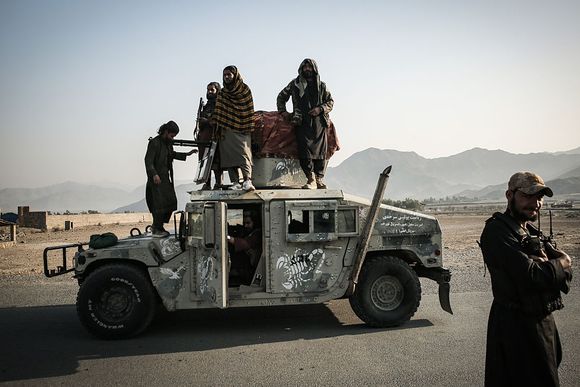
EU plans Taliban talks on Afghan deportations

🟢 Interview: Big Tech’s narrative edge fuels EU-US tech clash, says new DG COMP chief

🟢 Hungary’s Prime Minister-elect Magyar unveils his cabinet

Taliban fighters ride on an armoured vehicle (Photo by Sami Jan/picture alliance via Getty Images)

You don’t expect anything unusual when you step into one of Brussels’ polished hotels – just the familiar hum of conversation and policy chatter. And yet it’s getting easier to imagine a different kind of encounter. One where, over a drink, you might spot a Taliban delegation. Unlikely, perhaps, but no longer unthinkable.

Before the summer, EU officials are expected to host Taliban representatives in Brussels for talks on deporting Afghan nationals without the legal right to remain in the bloc, or convicted of crimes, officials familiar with the plans told me.

The meeting is being stitched together behind closed doors, pushed notably by Belgium’s migration ministry. Around the table, if all goes to plan, will sit officials from the European Commission, the European External Action Service and selected national governments, including Sweden.

One EU official said the invitation would likely be issued by the Commission, with Swedish backing. Belgium is expected to facilitate visas for the Afghan delegation, though officials stressed that the invitation itself would not formally come from the country, reflecting political sensitivities in Brussels. Foreign Minister Maxime Prévot has been reluctant to issue an invitation directly.

Preparations have been under way for months. In January, EU and Belgian officials travelled discreetly to Kabul, including Johannes Luchner, deputy director in the Commission’s migration department, and Freddy Roosemont, head of Belgium’s Immigration Office.

A photo from that visit seen by Rapporteur – Luchner, Roosemont and an EEAS official, smiling in front of a mural – captures the normalisation of what would once have been unthinkable.

Since regaining power in 2021, the Taliban have imposed a strict authoritarian system, curtailing basic freedoms and excluding women from public life. They barred girls from secondary school that year and banned women from university education in 2022.

The prospect of formal talks has drawn sharp criticism. “I find it utterly shocking that Europe would consider talks with the Taliban,” Socialist lawmaker Cecilia Strada told Rapporteur, calling it a regime enforcing gender apartheid. “The idea that European officials would enter into dialogue and negotiations … to send people back to Afghanistan is truly disturbing. Europe has completely lost its compass.”

Spanish leftist MEP Estrella Galán called the engagement with a regime that was not democratically elected “yet another moral decline.” Last year, a Belgian push for EU-wide coordination on deporting irregular and criminal Afghan nationals gained backing from 19 other countries.

Others argue the EU has delayed too long. Charlie Weimers, a Swedish ECR MEP, said discussions should have “commenced immediately after the fall of Kabul when the Taliban indicated willingness to take back their own citizens.”

Read the full story.

Jargon not the problem in EU-US tech fight

Just days into one of the most powerful roles in the EU bureaucracy, Anthony Whelan was still settling in – quite literally speaking from his old Madou tower office, having stepped up from deputy director-general in DG COMP.

A longtime confidant of Ursula von der Leyen on digital policy, the Irish official now sits at the centre of mounting transatlantic tensions over Europe’s tech crackdown. Washington’s frustration has been amplified by Silicon Valley giants, many directly in the EU’s regulatory crosshairs. But Whelan isn’t convinced Brussels has a messaging problem.

“I wouldn’t say jargon … is a main driver of differences in perception,” he told my colleague Anupriya Datta and me. The real issue, he suggests, is narrative power.

Most of the companies affected are American, he noted, and their dominance naturally makes their arguments “more immediately plausible” in US political debate. That asymmetry leaves Brussels on the back foot.

“It’s absolutely normal that the EU … is less audible than some of the most powerful and well-resourced companies in the world,” Whelan said.

Bosnia faces €400mn funding shortfall

Aspiring EU member Bosnia and Herzegovina stands to lose close to €400 million by the end of the year unless it accelerates reforms, Enlargement Commissioner Marta Kos warned the European Parliament on Monday.

The candidate country has yet to appoint a chief negotiator and has failed to pass two judicial reform laws required to unlock funding under the EU’s €1 billion Growth Plan. “This is not the European Commission working against the citizens, it is the politicians who do not deliver on the rules we have,” Kos said.

The country’s Croats, Serbs and Bosniaks don’t agree on who their negotiator should be. “I am afraid that they simply do not have a person who would be able to represent the country as a whole, not only one ethnic group,” said Czech MEP Ondřej Kolář, the European Parliament’s standing rapporteur on Bosnia and Herzegovina.

Without resolving this, “the country will fall behind in everything,” he added. The Bosnia and Herzegovina mission to the EU did not immediately respond to a request for comment.

US presses Belgium on antisemitism chief

Belgium and other European countries are facing mounting US pressure to appoint senior coordinators to combat rising antisemitism and protect Jewish communities.

Speaking in Brussels, US ambassador Bill White urged action as criticism grows in Washington over what it sees as an insufficient response from several European governments. In Belgium, senior politicians from right-wing parties such as Georges-Louis Bouchez have also called for such a role to be created. Read Eddy’s full story.

EU lags Russia in weapons production

Europe is falling behind Russia in the production of key weapons systems, widening a gap that EU defence chief Andrius Kubilius warned could embolden Moscow, according to my colleague Pietro Guastamacchia.

Addressing lawmakers in Parliament’s industry committee, Kubilius said the bloc must urgently scale up defence manufacturing. According to figures presented by the commissioner, Russia produces roughly 1,100 cruise missiles a year, compared with about 300 in the EU, while Moscow manufactures around 900 ballistic missiles annually against effectively none in the bloc.

Visits to defence manufacturers have highlighted structural constraints, he said, including a lack of long-term contracts and limited visibility on future orders – both largely dependent on EU capitals’ decisions. He also pointed to persistent bureaucratic obstacles, questioning why many remain unresolved.

A CENTURY OF EXPERIENCE: Michael Gahler chaired a meeting of the European Parliament’s foreign affairs committee on Monday – despite being neither chair nor one of its four vice presidents. As he noted, when all five are absent, the role falls to the longest-serving MEP. Gahler fits the bill: he has been an MEP since 1999!

BUDAPEST 🇭🇺

PM-elect Péter Magyar has unveiled seven cabinet picks, blending technocrats with figures tied to Viktor Orbán’s outgoing administration. Former Shell plc executive István Kapitány is set to take the economy and energy portfolio, with former state secretary András Kármán at finance and former ambassador Anita Orbán at foreign affairs. Surgeon Zsolt Hegedűs would take health, while zoo director László Gajdos is slated for environment. Controversy surrounds defence nominee Romulusz Ruszin-Szendi, facing a corruption probe, and agriculture pick Szabolcs Bóna.

Mátyás Varga

WARSAW 🇵🇱

Emmanuel Macron met Donald Tusk in Gdańsk for the first Franco-Polish cabinet session under their 2025 Treaty of Nancy, signalling closer defence ties amid concerns over Russia and US reliability. Talks covered military cooperation, a joint satellite project and a potential Polish role in France’s nuclear deterrent. Despite convergence, Warsaw remains more cautious than Paris about loosening reliance on Washington. Read more.

Karolina Wójcicka

STOCKHOLM 🇸🇪

Swedish military intelligence has warned of mounting economic strain in Russia, urging EU allies to step up support for Ukraine and adopt a 20th sanctions package. Intelligence chief Thomas Nilsson said “serious problems” in the Russian economy could curb future military capabilities. Vladimir Putin has also cautioned growth may slow, saying gains from higher oil prices are likely to prove temporary.

Emiliia Ternovskaia

THE HAGUE 🇳🇱

The European Court of Justice capped detention for rejected asylum seekers at 18 months, prompting the release and compensation of 30 detainees in the Netherlands. Asylum Minister Bart van den Brink warned the ruling could weaken migration controls by limiting deportations after the deadline. He proposed criminalising illegal residence to allow detention in prison, but faces opposition from within his party and beyond.

Emiliia Ternovskaia

PRAGUE 🇨🇿

The foreign ministry has lodged a formal protest with Russia’s ambassador after Moscow labelled Czech drone manufacturers “potential military targets” for supplying Ukraine. Prague called the rhetoric “inadmissible,” stressing all support complies with international law. Police said there is no immediate threat but are monitoring the situation and coordinating with affected firms.

Aneta Zachová

BRATISLAVA 🇸🇰

President Peter Pellegrini refused to include early elections in a planned referendum, despite a petition with nearly 400,000 signatures. The July vote will instead address abolishing Robert Fico’s lifelong pension and restoring anti-corruption bodies dismantled by his government. Pellegrini said the early elections question was unconstitutional, but did not seek a Constitutional Court ruling.

Natália Silenská

ROME 🇮🇹

A clause in Italy’s security decree offering €615 to lawyers who encourage migrants to opt for voluntary return has sparked backlash over professional independence. President Sergio Mattarella is reportedly scrutinising the measure ahead of the 25 April deadline to convert it into law. Opposition parties, lawyers and judicial bodies warn it risks conflicts of interest, adding pressure on the government to amend the provision.

Alessia Peretti

MADRID 🇪🇸

The wife of Pedro Sánchez, Begoña Gómez, on Monday asked a judge to dismiss corruption charges, arguing there is no solid evidence. The private prosecution led by Hazte Oír is seeking a 24-year prison sentence and travel restrictions, citing a risk of flight.

– Inés Fernández-Pontes

China is weighing a risky release of sanctioned Iranian crude stored at its ports, a move that could expose Beijing to US secondary sanctions as proceeds may flow directly to Tehran’s military. With up to 10 million barrels still in storage and transfers already under way via a shadow fleet, Washington has warned that any entities facilitating such trade could face punitive measures.

author_name Newsletter Editor
Eddy Wax
author_name Politics Reporter
Nicoletta Ionta

Contributors: Anupriya Datta, Thomas Moller Nielsen, Pietro Guastamacchia, Magnus Lund Nielsen

Editors: Christina Zhao, Sofia Mandilara, Charles Szumski

Euractiv
Euractiv Media BV - Boulevard Charlemagne 1, Brussels 1041 - Belgium
Copyright © 2026. All rights reserved.