Also, Cork, Bardella raids, unanimity
Rapporteur
Powered by

You’re reading Rapporteur on Wednesday 1 July. This is Eddy Wax in Brussels, with Nicoletta Ionta en route to Dublin.

Need-to-knows:

🟢 EPP hardens on migration before key elections

🟢 Cork, Ireland’s second city, takes centre stage

🟢 National Rally faces raids across Europe

Powered by Amazon
Can private investment close Europe's green gap?

New Frontier Economics research quantifies Amazon's €17bn contribution to the low-carbon transition. Click here to find out how Amazon is powering Europe's low-carbon economy. 


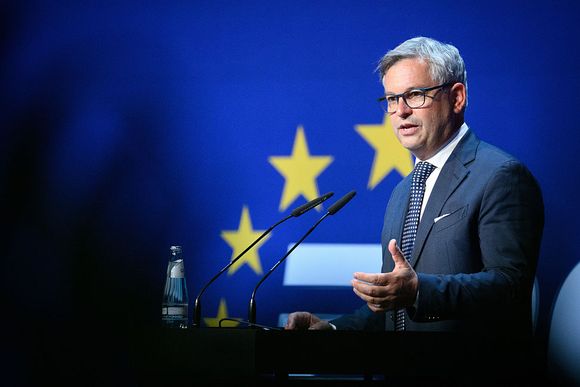
Magnus Brunner (Photo by Bernd von Jutrczenka/picture alliance via Getty Images)

The ink is barely dry on the EU’s new deportations bill, but there are already calls for migration policy to get even tougher.

In Vienna on Tuesday the EPP, Europe’s pre-eminent political force, adopted a resolution calling for another turn of the screw.

The Austrian centre-right party of Magnus Brunner, the EU migration commissioner, was central to the push at an EPP political assembly to make it harder for asylum seekers to gain protection in the bloc.

The EPP is so dominant that the ideas tested at its internal meetings often move quickly into the Brussels mainstream.

Why now? Look to Germany. Two regional elections in September are worrying the EPP, with the far-right AfD polling ahead of Friedrich Merz’s CDU party and campaigning on a pledge to upend the migration consensus.

The CDU secured an amendment calling for the Commission to propose “further legislative measures to prevent illegal migration into the EU,” including an “explicit right” for countries to reject asylum claims where migrants are being “instrumentalised” at the EU’s borders.

That would move EU law closer to the approach already taken by Poland, where Donald Tusk has accused Russia of deliberately pushing migrants across the border with Belarus.

Taken together, the proposals point to a broader shift. The centre-right is no longer focused only on speeding up returns, but on narrowing access to protection itself.

The EPP also wants to update the migration pact to “abolish the status of subsidiary protection to allow a faster return of refugees after the end of a civil war in their countries of origin.”

Subsidiary protection is granted to people who do not qualify as refugees but would face serious harm if returned home because of war or widespread violence. The idea featured in earlier EPP declarations this year, but its endorsement by the party in Vienna is another sign of how fast the migration debate is hardening.

In France, Poland, Italy and Spain migration remains near the top of the agenda ahead of elections next year, as centre-right parties face growing competition from far-right rivals campaigning on promises of tougher border controls and reduced asylum rights.

The Cork connection

Ireland’s second city – or the “real capital” if you ask the locals – is about to host 27 European Commissioners. Ursula von der Leyen and the rest of the College will arrive on Thursday for a visit marking the start of the country’s rotating EU Council presidency.

Cork and Dublin have long been locked in a friendly, if sometimes less than friendly, rivalry over which is the better city. But this presidency looks like Cork’s moment in the sun.

Many of the key players of the presidency hail from Cork, from Micheál Martin, the prime minister, to European Commissioner Michael McGrath and Aingeal O'Donoghue, Ireland’s ambassador to the EU.

“It’s a sign we’re trying to spread the presidency around the country,” Thomas Byrne, Ireland’s Europe minister and a Meath man, told Rapporteur.

Cork, known as “Rebel County,” played a central role in Ireland's fight for independence as the home of Michael Collins, who masterminded the guerrilla war against British forces. Ralph Riegel, who covers Cork for our sister paper The Irish Independent, told me it is now a booming city, set to grow by 60% by 2040 and attract an extra 125,000 people.

MEP Billy Kelleher, another Cork politician, said his city has a lot to offer, describing it as being at “the fore in our blow for freedom.”

Kelleher, the deputy leader of Renew Europe, told me that the debate over scrapping national vetoes would be a central part of the Irish presidency. Read the full interview.

Raids at RN

Investigators working with the European Public Prosecutor’s Office carried out coordinated raids across France, Belgium, Italy and Spain on Tuesday as part of a probe into the alleged misuse of €4.33 million in European Parliament funds by the former Identity and Democracy group, which included France's National Rally (RN).

The probe follows an internal European Parliament audit first revealed by Euractiv.

French newspaper Le Canard Enchaîné also reported that prosecutors were considering opening an investigation into Jordan Bardella, president of the RN, over allegations that documents were forged to substantiate work he carried out as an accredited assistant.

Bardella suggested the measures were politically motivated. “We have nothing to be ashamed of, and we will prove it,” he said.

Leftist French MEPs to watch

In the final part of our series on the MEPs shaping France's presidential race, Euractiv turns to the fractured left.

Nine months before the election, France’s left remains divided over both its candidate and its strategy. Jean-Luc Mélenchon is still the contender best placed to reach the second round, but his polarising profile continues to alienate potential allies.

Meanwhile, the Socialist Party has yet to settle on a candidate, while S&D MEP Raphaël Glucksmann is still seeking to transform his European election momentum into a progressive coalition. Read Elisa Braun’s full story.

Here are three new stories from Euractiv:


EUROPE BUCKS GLOOMY TREND: Europeans are growing markedly more pessimistic about the future of the world, even as confidence in the EU holds up. A new European Parliament Eurobarometer found that 58% are now pessimistic about the world's future, up six points since last year, while just 38% remain optimistic. By contrast, 59% are optimistic about the EU's future and 76% about their own family.

FROM TARIFFS TO FRIENDS: EU-US trade talks may have been bruising, but they did at least produce one unlikely friendship. US Ambassador Andrew Puzder had warm words for Bernd Lange, the German Socialist who led Parliament’s work on the deal, saying that after a year of negotiations he could still call him a friend. Lange recently told Euractiv the pair bonded over a shared love of motorbikes.

CORRECTION: Tuesday's Rapporteur incorrectly stated the number of times the French far right has reached the presidential run-off. The correct figure is three.


BUDAPEST 🇭🇺

Hungary has begun dismantling the public-interest asset management foundations created under Viktor Orbán, taking direct state control of dozens of institutions as part of efforts to unlock €10.4 billion in frozen EU funds. A decree that entered into force on Tuesday transfers the state's rights as founder to ministers, with most non-university foundations due to return to state ownership by 31 August. Read the full story.

– Mátyás Varga

PARIS 🇫🇷

France has set 18 April and 2 May 2027 as the dates for the two rounds of its next presidential election, ending months of uncertainty over the electoral calendar. The vote will overlap with the country’s spring school holidays, a scheduling choice that could affect turnout in some regions.

– Elisa Braun

WARSAW 🇵🇱

Poland will not send its remaining MiG-29 fighter jets to Ukraine after a proposed swap for Ukrainian drone technology collapsed, Defence Minister Władysław Kosiniak-Kamysz said. He said Kyiv had withdrawn from the arrangement after initially accepting it, leaving Poland without the expected cooperation. The setback comes as relations between the two allies have become increasingly strained. Read the full story.

– Pietro Guastamacchia

PODGORICA 🇲🇪

EU governments have approved the drafting of Montenegro's accession treaty, paving the way for the Balkan country to join the bloc in 2028. Seeking to reassure capitals as budget negotiations intensify, the European Commission said membership would cost the bloc about €3.2 billion between 2028 and 2034, or less than €1 per EU citizen each year, while boosting growth and integration. Read the full story.

– Bruno Waterfield

SOFIA 🇧🇬

Bulgaria and Turkey agreed on Tuesday to work with the European Commission to develop the Middle Corridor, the Europe-Asia trade route Brussels is promoting as an alternative to transit through Russia. After talks with his Turkish counterpart, Bulgarian Transport Minister Georgi Peev said the two countries occupy a "strategic position" along the route. The ministers also agreed to strengthen cross-border road and rail freight links.

– Konstantin Karadjov

SARAJEVO 🇧🇦

A senior US diplomat will temporarily oversee Bosnia's international peace office after the US and European members of the Peace Implementation Council failed for a second time this month to agree on a permanent successor to outgoing High Representative Christian Schmidt. Louis J. Crishock will assume the role on Wednesday, with the council aiming to appoint a permanent high representative by 14 July amid continued disagreement with Russia.

– Bronwyn Jones

Advertisement
Amazon
 

Eddy Wax Newsletter Editor
Eddy Wax
Nicoletta Ionta Politics Reporter
Nicoletta Ionta
 

Contributors: Sofia Sanchez Manzanaro, Elisa Braun, Martina Monti, Magnus Lund Nielsen

Editors: Christina Zhao, Sofia Mandilara, Charles Szumski

Euractiv
Euractiv Media BV - Boulevard Charlemagne 1, Brussels 1041 - Belgium
Copyright © 2026. All rights reserved.