Also, Plenković blasts EU response to Mladić funeral
Rapporteur
Sponsored by

You’re reading Rapporteur on Tuesday 8 September. This is Eddy Wax in Brussels, with Nicoletta Ionta.

Need-to-knows:

🟢 Franco-German cracks emerge over EEAS reform

🟢 Croatian PM blasts EU leaders over Mladić funeral

🟢 EU ambassadors debate new taxes in budget battle

Sponsored by RTX
A new day dawns for the MALD

Raytheon, an RTX business, is preparing a rapid production restart for the MALD decoy – a battle-tested, air-launched system that meets the U.S. and NATO allies’ surging and urgent demand for protection against enemy air defenses. Learn more here.

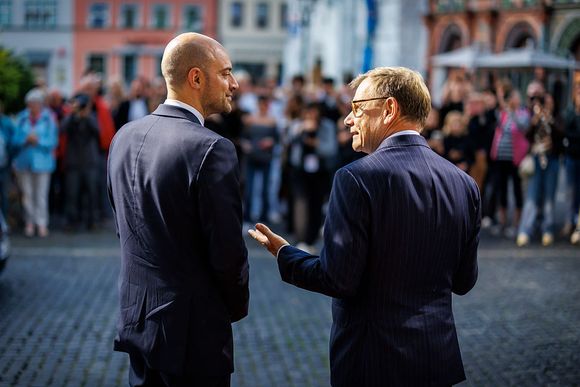
Jean-Noël Barrot and Johann Wadephul [Thomas Imo/Photothek for the German Federal Foreign Office via Getty Images]

Last week, Germany and France presented a united front as they kicked off a debate on reforming the European External Action Service.

They had already aligned on an ambitious timeline: sewing up the reform by the end of the year. EU leaders may discuss it at the European Council in mid-October.

But the flurry of diplomatic papers and behind-the-scenes briefings suggests Berlin and Paris are not fully in sync on how to change the way the bloc conducts foreign policy.

After we published Germany’s ideas in full on Monday, Paris distanced itself from Berlin’s blueprint.

The German plan – which predates the joint initiative, according to two sources familiar with the process – leans heavily towards folding the EEAS into the Commission. That could leave Kaja Kallas, or whoever occupies the post of high representative for foreign affairs, subordinate to the Commission president, an outcome unlikely to please Paris.

France has been irked this year by the tight control Ursula von der Leyen’s Commission has exerted over foreign policy, arguing it is not the institution’s domain.

Johann Wadephul, Germany’s foreign minister, has however called for the EEAS and Commission to be “closely dovetailed.” The Commission controls important foreign policy areas, from development to defence – as well as the purse strings.

France has been more outspoken about strengthening Kallas’ role and has explored making her the Commission’s “first executive vice president.” Jean-Noël Barrot, the French foreign minister, explicitly said in Ireland last week that Kallas and her office should be reinforced.

Adding to the confusion, it was Germany’s non-paper – not a joint Franco-German document – that was being carried around in at least one official’s bag at last week’s informal Foreign Affairs Council. Not all countries were consulted before the meeting, raising further questions about who is driving the process.

Two diplomats told me there was also uncertainty over whether Barrot’s Quai d’Orsay or Emmanuel Macron’s Élysée was directing the drafting of France’s position.

Plenković blasts EU’s Mladić response

Croatian PM Andrej Plenković accused Brussels of responding too weakly to the funeral of Bosnian Serb commander and convicted war criminal Ratko Mladić.

Mladić’s coffin was transported on a government plane and escorted by Serbian Armed Forces personnel, while senior Serbian officials attended Monday’s service. “It is up for Serbia to decide how to go about the funeral,” a Commission spokesperson said, while insisting it was not held with state honours.

Plenković said it was “very serious” that the Commission responded only through a spokesperson, accusing von der Leyen, Kallas and António Costa of failing to speak out themselves.

On Friday, Marta Kos, the enlargement commissioner, announced the cancellation of her visit to Serbia this week over the funeral row.

Von der Leyen is also due to visit the Western Balkans soon, although it remains unclear whether Serbia will be included. The Commission confirmed her annual trip but said the itinerary was still being finalised and might not cover every country.

EU budget talks get taxing

We’re still far from the late nights and painful compromises needed to unlock an EU budget deal later this year.

But a politically charged phase of the negotiations begins today, when EU ambassadors hammer out their differences on new ‘own resources’ – or in human speak, fresh revenue streams for the bloc’s strained coffers.

Costa has repeatedly stressed that agreeing on a basket of new revenues – potentially including levies on carbon, companies and cigarettes – is a prerequisite for landing a deal.

He will meet Friedrich Merz in Berlin on Wednesday, the first frugal leader he will encounter on his ongoing tour des capitales.

Costa’s strategy is aimed at heading off demands from Merz and his allies for sweeping cuts to the EU’s next seven-year budget, or Multiannual Financial Framework. The calculation is that securing a sizeable package of new revenues would soften the blow.

But Zsolt Darvas, an economist at the Bruegel think tank, said new ‘own resources’ were no silver bullet because the burden of most would largely fall on national budgets. “In my view new own resources are not important at all,” he said. Darvas predicted that a deal would likely materialise only after haggling over national rebates, which he argued should be scrapped.

Meanwhile, levies on carbon emissions and electronic waste have emerged as frontrunners for inclusion in the package, according to a document seen by my colleague Victoria Becker and Nicoletta. Read their full story.

Migration matters less in Sweden’s election

Sweden’s upcoming election may change the government, but it is unlikely to alter the direction of migration policy.

PM Ulf Kristersson’s centre-right government has tightened immigration rules and pushed tougher integration measures, bringing Sweden closer to neighbouring Denmark.

Migration and crime once dominated Swedish election campaigns. This time, immigration ranks only fourth among voters’ concerns, while the debate has shifted towards language requirements, self-sufficiency and stronger expectations that newcomers adapt to Swedish society.

Even a Social Democrat-led government would face pressure to maintain much of this tougher approach. Read David Mac Dougall’s full story.

Here are three new stories from Euractiv:

Advertisement
RTX

BRAVISSIMO: Giorgia Meloni applauded Bart De Wever for his use of Italian at a meeting in Rome on Monday, according to Belga. The Flemish linguist may also have won her favour by calling for the EU’s southern border to be strengthened.

BERLIN 🇩🇪

Friedrich Merz warned that “business as usual” was impossible and that the CDU’s devastating Saxony-Anhalt defeat would have consequences. The far-right AfD won 43.8% and 39 seats, equalling the combined total of the CDU, Left, SPD and Greens. Its lead candidate, Ulrich Siegmund, will seek the premiership and court rival groups or individual lawmakers to secure a majority. The BSW’s Thomas Schulze signalled openness to an AfD coalition, citing shared opposition to Russia sanctions. Read the full story.

– Björn Stritzel

PARIS 🇫🇷

Far-right leader Marine Le Pen has called for a freeze on French tobacco taxes and for prices to be indexed to inflation, pledging EU-level talks to curb cross-border competition facing retailers. Her remarks come as capitals negotiate an overhaul of the bloc’s Tobacco Excise Directive, which would sharply raise levies on tobacco and nicotine products but is stalled by Swedish opposition. France has pushed for similarly high taxes across the EU. Read the full story.

– Sarantis Michalopoulos

NUUK 🇬🇱

Ursula von der Leyen capped her Greenland visit by unveiling a long-awaited €200 million package for telecoms, infrastructure, housing and mining. The funding comes alongside the Commission’s proposal to double Greenland’s annual EU allocation to €76 million. “Greenland needs the European Union, and the European Union needs Greenland,” Premier Jens-Frederik Nielsen said alongside von der Leyen and Mette Frederiksen.

– Magnus Lund Nielsen

MADRID 🇪🇸

Spain’s National Court opened an investigation into July’s mass influx of more than 80,000 migrants into Ceuta, which killed more than 100 people. Judge María Tardón said the organised crossings threatened Spain’s territorial integrity and could constitute “hybrid warfare” or “grey-zone” tactics. She argued that Morocco’s “permissive” approach had enabled an operation intended to undermine Spain’s national security.

– Inés Fernández-Pontes

BELGRADE 🇷🇸

Serbia’s government proposed dissolving parliament on Monday, paving the way for snap elections in October after almost two years of student-led protests and political turmoil. President Aleksandar Vučić has 72 hours to decide whether to accept the request. Polls point to the most competitive contest since the centre-right SNS took power in 2012, with the ruling party and student movement emerging as the strongest forces amid strained relations with Brussels. Read the full story.

– Pavle Kosić

DUBLIN 🇮🇪

Ireland will tighten its naturalisation rules, Micheál Martin said. Applicants would generally need eight years’ residency, up from five, pass an English-language test, demonstrate basic knowledge of Irish and prove economic self-sufficiency. Justice Minister Jim O’Callaghan is expected to put the overhaul to cabinet this week as part of what Martin called a “firmer and more robust” migration system.

– Charles Szumski

WESTERN BALKANS 🇧🇦🇲🇪🇲🇰🇷🇸

Truck drivers from Bosnia and Herzegovina, Serbia, Montenegro and North Macedonia plan to blockade EU border crossings from next Monday over the Schengen area’s 90-in-180-day limit. The bloc’s Entry/Exit System, fully operational since April, has made the rules easier to enforce. Hauliers are demanding an exemption allowing drivers to remain longer, warning that the restrictions threaten regional freight and supply chains.

– Bronwyn Jones
Eddy Wax Newsletter Editor
Eddy Wax
Nicoletta Ionta Politics Reporter
Nicoletta Ionta

Contributors: Victoria Becker, David Mac Dougall, Bruno Waterfield

Editors: Christina Zhao, Sofia Mandilara, Charles Szumski

Euractiv
Euractiv Media BV - Boulevard Charlemagne 1, Brussels 1041 - Belgium
Copyright © 2026. All rights reserved.