Also, Israeli ambassador, Cyprus, von der Leyen’s speeches, return hubs
Rapporteur
Powered by

NEW WEEK, SAME BLOCKAGE: Slovakia’s Robert Fico said he will meet Ursula von der Leyen on Tuesday as he escalates threats to block the EU’s €90 billion emergency loan for Ukraine – a veto previously wielded only by Hungary. Already blocking the 20th Russia sanctions package, Fico said Slovakia would help repair the Druzhba oil pipeline after Kyiv said it was damaged in a Kremlin-ordered drone strike.

“The most important message will be that Slovakia is ready to take over the baton from Hungary, if necessary,” Fico said, calling his threat to veto the EU loan a “legitimate tool” to restore oil flows. Both leaders will attend Tuesday’s nuclear energy summit in Paris. A one-on-one meeting could help Fico domestically and provide the off-ramp he needs to climb down. Or not.

You’re reading Rapporteur on Monday 9 March. This is Eddy Wax, joined by Nicoletta Ionta as we make our way to Strasbourg despite Belgian train strikes.

Need-to-knows:

🟢
The European left’s anti-war moment

🟢 Israel’s envoy to the EU says international law needs updating

🟢 How von der Leyen’s rhetoric has evolved

Powered by Amazon
Businesses across Europe grow with the AWS Cloud

xFarm uses the AWS Cloud to support the digital evolution of farming. Its platform helps farmers improve productivity, make data-driven decisions, and keep sustainability at the core of their operations while supporting innovation across Europe. Find out more.

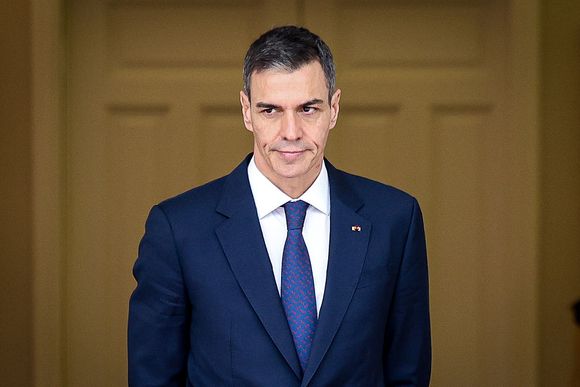
Spanish Prime Minister Pedro Sánchez (Photo by Paolo Blocco/Getty Images)

Supporters of Pedro Sánchez chanted his new slogan – “No to war” – at a party rally on Saturday, as Spain’s oft-underestimated prime minister rides high on his criticism of the US-Israeli war in Iran.

Sánchez has framed the conflict as a threat to hard-won cost-of-living policies, such as low electricity prices, and a test of national sovereignty.

“Seeing the impact from the position that Spain’s government has taken, I can say loud and clear that one can be proud to be Spanish,” he told the party faithful.

Other centre-left figures across Europe appear to have taken notice, perhaps spotting a chance to revitalise social democracy at a very low ebb. Their strategy? Distance themselves from the war while arguing their policies are best placed to insulate Europe from its economic consequences.

In Germany, Vice Chancellor Lars Klingbeil of the Social Democratic Party of Germany said the conflict was “not our war” and expressed “great doubts” about its legality, taking an alternative stance to his senior coalition partner, Friedrich Merz. (The SPD took a beating in a regional election on Sunday, anyway).

António Costa, in a speech on Friday, put a toe outside his usually cautious remit, saying that while Iran bears "responsibility for the root causes,” “unilateralism can never be the path forward” – the closest any EU-level leader has come to criticising the US-Israeli attacks. Costa previously served nine years as Portugal’s social democrat prime minister.

Walloon socialist Paul Magnette, an opposition leader in Belgium, made a tub-thumping parliamentary speech last Thursday against the war, saying not a single Belgian weapon or soldier should participate.

In the UK, however, Keir Starmer appears unable to convert Britain's distance from the conflict into electoral advantage. Letting the US use British bases has not placated Donald Trump, who’s recently described him as “no Winston Churchill.”

Responding with Sánchez’s “no to war” chant would probably help him beat back the rising Green Party.

But clashing with Trump isn’t without risks for Starmer. While Spain knows the entire EU will defend it from Trump’s trade threats, post-Brexit Britain is far more vulnerable to them.

And Starmer is likely calculating that copying Sánchez would further risk the already diminished US involvement in NATO and Ukraine, where the UK plays a larger role than Spain.

Interview: Israel’s ambassador to the EU

International law needs stronger leadership and may need to be “updated” to reflect modern security threats, Israel’s ambassador to the EU, Avi Nir-Feldklein, told Rapporteur in an interview on Friday.

Some European leaders, including Sánchez, have criticised Israel and the US for breaching international law with strikes on Iran. Emmanuel Macron said the attacks took place “outside” international law.

“I can envy those countries that are not under such a threat that they can pursue a beautiful philosophy,” Nir-Feldklein said. “But [they are] not in our position when the sword is on our neck. I wish they would never understand our reality.” The Iranian threat to Israel was existential, he added.

“We’re in a totally different world,” he said, pointing to terrorism and hybrid warfare. "Shouldn't we try to craft our rules differently?”

Nir-Feldklein said Iran’s alleged use of cluster bombs against Israeli civilians was among the reasons international law needs to be urgently “updated.” “It should be giving answers to real problems,” he said, likening Israel’s position to a gymnast facing a kickboxer.

Iran lashing out at countries in the Gulf, as well as Turkey, Cyprus and Azerbaijan was aimed at increasing pressure on Washington to end the war, he said. Tehran could also seek to orchestrate attacks in Europe to push European leaders to press the US to halt the conflict.

“The way the regime is acting right now shows they are willing to use everything they have in their hands,” said the envoy, who has previously served in Germany and Norway.

“What you can see with your eyes is the frigates going towards Cyprus. What you don’t see is all the intelligence efforts happening right now on the continent to make sure that no terror attacks are taking place.”

Macron goes to Cyprus, ministers stay home

All EU Council meetings scheduled in Cyprus in March will either move online or be rescheduled to avoid travel disruptions, a Cypriot official said, after British airbases on the island were targeted by drone strikes last week.

Macron and Kyriakos Mitsotakis are nonetheless due to travel to Cyprus today. Macron announced last week that France would deploy the aircraft carrier Charles de Gaulle to the eastern Mediterranean.

Other EU countries, including Italy, Greece and the Netherlands, have also mobilised assets in response to the risk of attacks on Cyprus.

Costa and von der Leyen will also hold a video call with Middle Eastern leaders today to discuss the evolving security situation.

Von der Leyen’s ‘raw power’ rhetoric

Von der Leyen will address the EU’s 145 ambassadors around the world this morning, reflecting a broader shift in her messaging as she recasts herself from Green Deal pioneer to geopolitical powerbroker.

The transformation has been swift. Her speechwriting team has expanded from two writers in late 2024 to five today, as the Commission seeks to project urgency and strategic independence at a time when the EU is often perceived globally as slow and reactive.

The punchlines of a VDL 2.0 speech are by now recognisable:

“Battle lines for a new world order based on power are being drawn right now. So, yes, Europe must fight.” (September 2025)

“We have developed a new urgency mindset to address the challenges.” (June 2025)

“The world has changed permanently” (January 2026)

“We now live in a world defined by raw power – whether economic or military, technological or geopolitical. And while many of us may not like it, we must deal with the world as it is now.” (European Parliament, January 2026)

“So many of our illusions are being shattered … Europe is called to take greater charge of its own defence.” (March 2025)

“Europe must show strength … Europe must show strength … Europe must show strength.” (July 2025)

Return hubs vote

Lawmakers on the European Parliament’s civil liberties committee will vote today on the EU’s proposed Returns Regulation, a central pillar of von der Leyen’s migration agenda. The proposal would introduce so-called “return hubs” – facilities outside the bloc where migrants whose asylum claims have been rejected could be sent.

On Thursday, the EPP and other right-leaning groups struck a deal to advance the legislation, agreeing on a compromise that sidelines liberal rapporteur Malik Azmani. They are now expected to back the proposal in today’s committee vote.

BERLIN 🇩🇪

Friedrich Merz has suffered a setback after the Christian Democratic Union failed to win back Baden‑Württemberg from the Greens (Alliance 90/The Greens). The wealthy state, home to Mercedes-Benz Group, with a population larger than Hungary’s, remained under Green control despite Merz’s confident final campaign push. The CDU has kept a low profile as attention shifts to elections in Rhineland‑Palatinate on March 22.

Nikolaus J. Kurmayer

PARIS 🇫🇷

France will carry out 500 checks at petrol stations between Monday and Wednesday to prevent excessive price increases linked to the war in the Middle East, PM Sébastien Lecornu said. The inspections by the consumer watchdog DGCCRF equal roughly six months of normal enforcement. The government said SP95-E10, the country’s most widely used petrol, rose 10 cents from a week earlier.

Christina Zhao

ROME 🇮🇹

Praise from Donald Trump for Giorgia Meloni is set to become a political flashpoint ahead of her expected address to parliament on Thursday. In a brief phone interview with Corriere della Sera, Trump described Meloni as “a great leader” and a “friend,” adding that she “always tries to help” when asked about Italy’s role in the US-Israel war in Iran. Opposition parties called the remarks “serious and troubling.”

Alessia Peretti

ZAGREB 🇭🇷

Croatia on Monday begins mandatory military conscription for the first time in 17 years, with an initial uptake of 800 recruits. The government aims to draft up to 4,000 people annually for a two-month service period. The Ministry of Defence says the programme reflects a revised defence strategy adopted last October in response to rising geopolitical tensions and will equip young people with skills for defence, crisis and emergency situations.

Bronwyn Jones

PRISTINA 🇽🇰

Kosovo is awaiting a ruling from the Constitutional Court on whether to proceed with snap elections after President Vjosa Osmani ordered parliament dissolved on Friday. PM Albin Kurti has asked the court to suspend the decision and review its legality after opposition parties boycotted a presidential vote in the assembly, missing the constitutional deadline. Osmani accused “irresponsible people with dangerous intentions” of causing the crisis.

Bronwyn Jones

KYIV 🇺🇦

Ukraine will send drone interception specialists to the Middle East
next week after a request from the US for help defending against Iranian-made Shahed drones, Volodymyr Zelenskyy said. The experts will travel with equipment to assess threats and assist regional partners. Zelenskyy said Kyiv was exploring ways to support Middle Eastern countries without weakening Ukraine’s own air defences.

Christina Zhao

Advertisement
Amazon

Europe’s €100 billion Future Combat Air System project is exposing a growing rift between France and Germany – and a shift in Berlin’s once-arm’s-length relationship with its defence industry. As the project stalls, Airbus and Dassault’s dispute has drawn politicians and workers into a public battle over jobs, influence and the continent’s military future.

US Democratic Senator Michael Bennet argues that Western allies should move ahead with seizing Russian sovereign assets to fund Ukraine if EU plans remain blocked, calling for a coalition of the US, UK, France, Germany and Canada to act by the July G7 summit in France. In an op-ed for Euractiv, Bennet says using Moscow’s frozen funds would demonstrate to Vladimir Putin that the West will not lose resolve.

author_name Newsletter Editor
Eddy Wax
author_name Politics Reporter
Nicoletta Ionta

Contributor: Nikolaus J. Kurmayer

Editors: Christina Zhao, Sofia Mandilara

Euractiv
Euractiv Media BV - Boulevard Charlemagne 1, Brussels 1041 - Belgium
Copyright © 2026. All rights reserved.