Also, Reza Pahlavi, Tisza lawmakers ban, Olivér Várhelyi, Hezbollah funding, mutual defence clause
Rapporteur
Powered by

You’re reading Rapporteur on Thursday 16 April. This is Nicoletta Ionta, joined by Eddy Wax in Brussels.

Need-to-knows:

🟢
Orbán’s exit leaves Janša without his key European anchor

🟢 Magyar’s EPP MPs remain barred from speaking rights

🟢 Exclusive: Intel report maps Hezbollah funding through Iran and shadow networks

Powered by EBB
Decarbonising EU transport with biodiesel

The total amount of GHG emissions in transport is still growing. Coherent policy is the missing link in the EU’s road to net zero. EBB President Dickon Posnett, breaks down why we need a technology-neutral strategy that includes sustainable biodiesel. Learn more here.

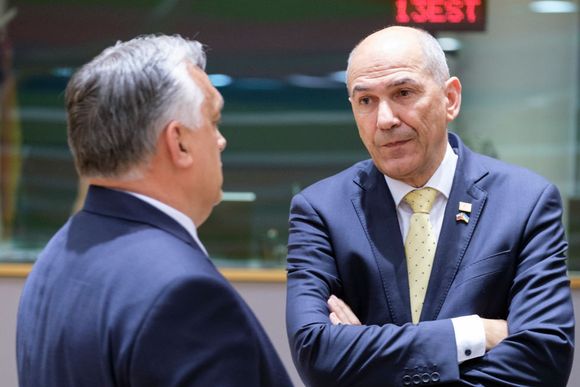
Viktor Orbán and Janez Janša (Photo by Thierry Monasse via Getty Images)

Hungary’s election has done more than end Viktor Orbán’s 16 years in power. It has also removed what, over the past decade, had become a central organising figure for Europe’s nationalist right.

Orbán’s exit from the European Council will deprive like-minded leaders across the bloc of a figure who played a central role in aligning positions among allied governments. Without that anchor, analysts told me the European far right is likely to become more fragmented and less capable of acting in concert.

Others are unlikely to step into that role. Czechia’s Andrej Babiš and Slovakia’s Robert Fico remain influential at home, but neither has shown the same capacity to organise across borders. As Júlia Pőcze of the Centre for European Policy Studies put it, they lack the “organising power” Orbán once wielded. That leaves his former allies more exposed and less cohesive.

The implications are already visible in Slovenia, where the prospect of a comeback by right-wing populist Janez Janša is now viewed through a more constrained lens. Without Orbán as a gravitational centre, figures such as the former Slovenian prime minister are more likely to be shaped by Europe’s mainstream centre-right than to reshape it, Milan Nič of the German Council on Foreign Relations told me.

For now, Slovenia is navigating uncertain waters. PM Robert Golob’s Freedom Movement secured only a razor-thin lead, but coalition talks have become more fraught after the election of Moscow-friendly politician Zoran Stevanović as speaker of parliament. Stevanović has signalled plans to visit Russia and floated a referendum on Slovenia’s withdrawal from NATO.

Janša’s decision to back Stevanović is “alarming,” liberal Slovenian lawmaker Irena Joveva told me, and it raises questions over the bargains behind Janša’s possible return. “Is this the price that he is paying to come back?” she asked.

President Nataša Pirc Musar is expected to give the mandate to whichever candidate appears most likely to secure 46 parliamentary votes, though neither bloc has a clear path to a majority.

Even so, casting Janša as a successor to Orbán would be a stretch. He is firmly pro-Ukraine, and, while eurosceptic, remains committed to staying within the European People’s Party rather than breaking away from it. Slovenia’s finely balanced parliament would also leave little room for the kind of systemic overhaul Orbán engineered in Hungary.

Orbán is leaving the stage, and with him goes the figure who for years gave Europe’s national right coherence beyond national borders.

Magyar still banned by EPP

Prime Minister-elect Péter Magyar’s MEPs return to the EPP next week as conquering heroes, but the Hungarian delegation remains barred from speaking for the group. The sanction, imposed by EPP chief Manfred Weber in January, followed Tisza’s refusal to defend the European Commission during a far-right no-confidence motion.

The ban runs until late July, meaning they will still be sidelined if Hungary comes up on the agenda later this month – as the Greens are expected to request. Read Eddy’s full story.

Exclusive: Key figures in the Hezbollah finance network

A Western intelligence assessment seen by Euractiv maps the financial architecture sustaining Hezbollah, tracing nearly $1 billion in Iranian funding since 2025 through oil revenues linked to China, shadow banking channels in Hong Kong, the UAE and Turkey, as well as exchange houses spanning Lebanon and Syria.

The report underscores how those networks – involving gold traders, front companies and informal hawala transfers – have helped the Iran-backed militia withstand Israeli military blows and continue financing both its military operations and welfare apparatus. My colleague Björn Stritzel has the full story.

Pahlavi says no to Parliament invite

Reza Pahlavi, former Persian Crown Prince and prominent Iranian opposition figure, turned down a foreign affairs committee invitation to speak at the European Parliament this week, despite lobbying by right-wing MEPs including hard-right Charlie Weimers and Sebastian Tynkkynen.

One of his supporters, Belgian-Iranian MP Darya Safai, suggested that inviting him alongside other opposition figures showed a lack of respect. Pahlavi remains a divisive figure within the Iranian diaspora, as recent protests during his Sweden visit showed. Read Pietro Guastamacchia and Eddy’s full story.

Várhelyi should stay, former commissioner says

A former European commissioner told my colleague Sarantis Michalopoulos that removing Olivér Várhelyi from his post as EU health chief would set a damaging precedent.

Speculation over his future was raised by Tisza officials, as we first reported this week, while Magyar pushes to oust Hungary’s Fidesz-appointed president.

Speaking anonymously, the former official said commissioners serve the EU rather than national interests and warned that forcing him out would “seriously undermine” that principle. “I expect Várhelyi to remain in his position,” they added.

A Commission spokesperson on Tuesday said “progress has been made” in an investigation into allegations – denied by Várhelyi – that an espionage‑recruitment operation linked to Hungarian intelligence was run from its embassy in Brussels during his tenure as ambassador.

EU readies defence guide

Defence Commissioner Kubilius said the Commission and the European External Action Service are preparing new mechanisms to tighten coordination of military aid, both before and after an EU country triggers the bloc’s mutual assistance clause.

The diplomatic service is already drafting guidance on what assets can be mobilised once the clause is invoked, alongside possible simulation exercises as early as next month, as Euractiv first revealed.

Kubilius floated a stronger coordinating role for the EU military staff in channelling support from national capitals. He said the EU could develop new mutual assistance instruments to allow countries to pre-plan what forces, equipment or support they could provide in a crisis. EU leaders are expected to discuss the clause at an informal summit in Cyprus next week.

Antisemitism rising in Belgium, US envoy warns

Bill White, the US ambassador to Belgium, who tussled with the government in February over ritual Jewish circumcision, has warned of rising antisemitism in the country.

“People are saying they no longer feel safe,” he said last night at an event hosted by the European Jewish Association (EJA). “Hearing that children and grandchildren are already moving away from Belgium, and that families no longer see it as a place where they want to build their future, is heartbreaking. No community should be made to feel that its only option is to leave.”

White was awarded the EJA’s King David prize at the conference, where Várhelyi and Roberta Metsola also expressed solidarity with Jews across Europe facing antisemitism. “If Jewish people do not feel safe in Europe, then Europe is not what it claims to be,” Várhelyi said, after an attempted firebombing of a synagogue in London on Wednesday.

Virkkunen joins power pantheon: Finnish Commissioner Henna Virkkunen has been named to TIME’s 100 Most Influential People of 2026, in an entry written by former Commissioner Margrethe Vestager. She appears alongside Mette Frederiksen, Mexican President Claudia Sheinbaum, US Secretary of State Marco Rubio and the Pope – plus designer Ralph Lauren, actor Ben Stiller, actress Dakota Johnson and figure skater Alysa Liu.

ROME 🇮🇹

Volodymyr Zelenskyy and Giorgia Meloni pledged closer defence co-operation in Rome, centred on joint drone and air-defence production. Zelenskyy promoted a “drone deal” model built on Ukraine’s wartime innovations, while Meloni confirmed Italy’s interest. In a pointed warning widely read as aimed at Donald Trump, she said any fractures in Western unity would serve Moscow’s interests.

Alessia Peretti

BUDAPEST 🇭🇺

Incoming PM Péter Magyar warned two Polish ex-officials granted asylum by Viktor Orbán – former Justice Minister Zbigniew Ziobro and his former deputy Marcin Romanowski – that Hungary will no longer shelter “international criminals.” Both face investigations in Poland over alleged financial misconduct, which they deny. Warsaw fears delays in government formation could give them time to flee, potentially to the US. Read more.

Karolina Wójcicka

MADRID 🇪🇸

Opposition leader Alberto Núñez Feijóo accused the ruling Socialists of concealing how many undocumented migrants would benefit from a regularisation decree approved on Tuesday, calling the measure “contrary to European law.” The Popular Party leader also criticised Pedro Sánchez for using a royal decree to bypass parliament, accusing the government of ruling against Congress and public will.

Inés Fernández-Pontes

WARSAW 🇵🇱

A Warsaw court dismissed Law & Justice party co-founder Jarosław Kaczyński’s lawsuit against Donald Tusk over remarks made at a 2023 rally, ruling they were protected political criticism. Kaczyński had sought damages after Tusk accused “those in power” of being “serial killers of women” over abortion-related deaths. The court said the comment did not directly target Kaczyński, though it said he could bear moral responsibility as a political leader.

Charles Szumski

PARIS 🇫🇷

France will not suspend energy savings certificates despite retailer pressure to ease fuel prices, Energy Minister Maud Bregeon said, rejecting claims by Michel-Édouard Leclerc that scrapping the scheme could cut pump prices by €0.15 a litre. Bregeon said the effect would be smaller, adding that the distributor-funded programme finances tangible energy transition measures.

Charles Szumski

BRATISLAVA 🇸🇰

Slovak authorities are investigating alleged illegal financing in the 2024 presidential campaign, including claims influencers were paid to back eventual winner Peter Pellegrini. Two Slovak influencers say they were offered at least €10,000 to promote a candidate, though accounts differ over who made the approach. Pellegrini denied the allegations on Wednesday.

Natália Silenská

PRISTINA 🇽🇰

EU Special Representative Peter Sørensen is due in Pristina on Thursday as Brussels seeks to revive the stalled Belgrade-Pristina dialogue. Sørensen met Serbian President Aleksandar Vučić last week to discuss implementation of existing agreements, after visiting Kosovo last month amid EU concerns over its draft Law on Foreigners. Kaja Kallas has said she will convene a high-level meeting between both sides.

Bronwyn Jones

BELGRADE 🇷🇸

Vučić has ordered the army to establish specialised attack drone units as part of a wider military modernisation drive. Though militarily neutral, Serbia remains in NATO’s Partnership for Peace and conducts joint exercises with the alliance. Belgrade has also bought weapons from China and France, and denounced a Croatia-Albania-Kosovo defence initiative as a security threat.

Bronwyn Jones

Advertisement
EBB

In an op-ed for Euractiv, Taciana Fisac, a professor of Chinese language and literature at the Autonomous University of Madrid, argues that Brussels’ public criticism of Beijing has yielded little diplomatic return and misunderstands the indirect, private modes of communication that shape Chinese political culture.

In her view, Pedro Sánchez’s China visit offers a more effective model for EU engagement: raising contentious issues such as human rights behind closed doors rather than through public confrontation.

author_name Newsletter Editor
Eddy Wax
author_name Politics Reporter
Nicoletta Ionta

Contributors: Brenda Strohmaier, Sarantis Michalopoulos, Pietro Guastamacchia, Charles Cohen

Editors: Christina Zhao, Sofia Mandilara, Charles Szumski

Euractiv
Euractiv Media BV - Boulevard Charlemagne 1, Brussels 1041 - Belgium
Copyright © 2026. All rights reserved.